


How Often Should I Get Tested for STDs? A 2026 Guide to Sexual Wellness

Testing. Treating. Caring. These three pillars form the foundation of true sexual wellness. Did you know that while common STD rates declined by 9% in 2024, cases of congenital syphilis have surged by nearly 700% over the last decade? This startling gap proves that many people are still missing the vital support they deserve. When you're trying to stay proactive about your health, the most common question is often, how often should I get tested for STDs?
It's natural to feel overwhelmed by conflicting online advice or to worry about facing judgment during a medical visit. We believe that healthcare should feel like a supportive partnership, not a source of anxiety. In this guide, we'll provide the latest 2026 CDC-backed testing frequencies tailored to your lifestyle, age, and risk factors to ensure your long-term wellness. You'll gain a clear understanding of testing window periods and learn how to access affordable, compassionate HIV/STD screenings in Charlotte. Let's move from uncertainty to empowerment together through consistent, proactive Care.
Key Takeaways
Master the 2026 CDC standards for routine screenings to transform preventative healthcare into a predictable, life-long habit of Wellness.
Determine exactly how often should I get tested for STDs by matching your screening schedule to your specific lifestyle and risk factors.
Understand the science of "window periods" to ensure your test results are clinically accurate and provide genuine peace of mind.
Overcome social stigma by viewing regular HIV/STD screenings as a powerful act of self-love and Community protection.
Access dignified Specialty Care and screenings in Charlotte that prioritize your health without judgment or barriers to Care.
Table of Contents
Standard STD Screening Guidelines for Every Stage of Life
Viewing sexual wellness as a foundational pillar of Primary Care changes the conversation from fear to empowerment. Routine testing is not a sign that something is wrong; it is a proactive step to ensure everything stays right. Many people use the terms interchangeably, but a sexually transmitted infection (STI) refers to the presence of a pathogen in the body, while a sexually transmitted disease (STD) occurs when that infection causes visible symptoms or damage. Because many infections are asymptomatic, waiting for symptoms is a risky strategy that can lead to unintended health complications.
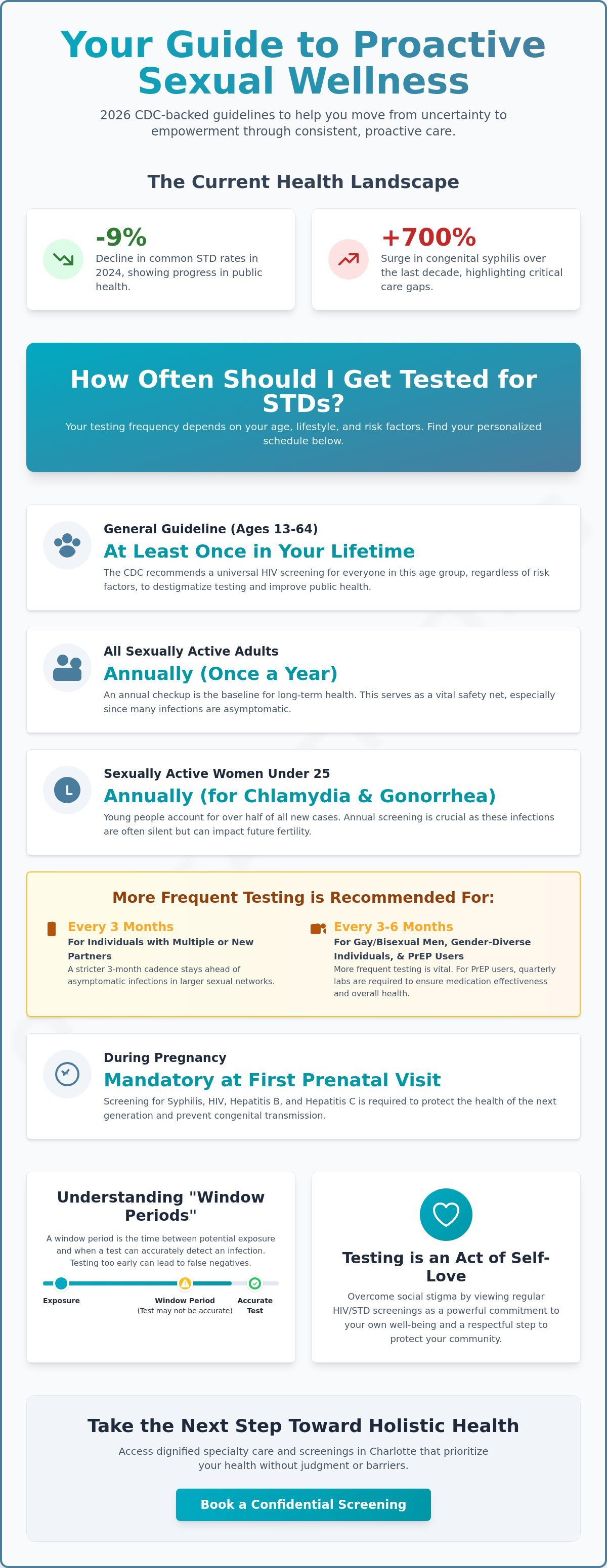
For the average sexually active adult, the baseline answer to how often should I get tested for STDs is at least once a year. This annual checkup serves as a vital safety net for your long-term health. Additionally, the CDC recommends that every individual between the ages of 13 and 64 receives an HIV screening at least once in their lifetime, regardless of their perceived risk factors. This universal approach helps destigmatize the process and ensures that everyone has access to life-saving information and treatment options.
Annual Testing for Adults Under 25
Younger populations face unique biological and social vulnerabilities that require specific attention. Statistics show that over half of all new cases occur in people aged 15 to 24. For sexually active women under 25, annual screenings for Chlamydia and Gonorrhea are essential because these infections often go unnoticed. We prioritize confidential Pediatric Care and teen health services to provide a safe, judgment-free space where young people can take charge of their futures. Protecting your health today ensures your fertility and Wellness tomorrow.
Routine Screenings for New or Monogamous Relationships
Starting a new chapter with a partner is an exciting time that deserves a foundation of trust. We encourage "the talk" to happen before physical intimacy begins. This conversation should include a commitment to baseline testing so both partners feel secure. A common myth suggests that monogamy removes the need for testing, but many infections can lie dormant for years without detection. When couples ask how often should I get tested for STDs within a partnership, we often suggest a joint screening at the start of the commitment. Testing together is an act of mutual respect and a shared investment in your collective Care. It ensures that you are entering the relationship with a clear understanding of your health status, allowing for a deeper, worry-free connection.
When Your Personal Risk Profile Requires Frequent Testing
Personal wellness isn't a one-size-fits-all journey. While annual screenings serve as a baseline for many, your unique lifestyle may require a more rhythmic, frequent approach to Care. Determining how often should I get tested for STDs depends largely on the activities and connections that define your current life stage. For individuals with multiple partners, or those in communities where certain infections are more prevalent, waiting twelve months between checkups can leave too much to chance. We view frequent testing as a rhythmic act of self-advocacy and community protection.
Specific populations, including gay and bisexual men and gender-diverse individuals, often benefit from testing every 3 to 6 months. This increased frequency is particularly vital for those utilizing PrEP (Pre-Exposure Prophylaxis) as part of their Specialty Care routine. PrEP is a powerful tool for HIV prevention, but it requires a commitment to quarterly lab work to ensure your body remains healthy and the medication remains effective. Consulting with a provider about what STD tests are right for you helps tailor this schedule to your specific needs. If you ever suspect a specific exposure, don't wait for your next scheduled appointment. Immediate action is the best way to maintain your peace of mind and your health.
Guidelines for Multiple or Rotating Partners
In larger sexual networks, the cumulative risk of exposure naturally increases. For those with frequent new partners, we recommend a strict 3-month testing cadence. This schedule allows you to stay ahead of asymptomatic infections and provides clear, documented results you can share with partners. Staying organized with your health records is a sign of maturity and respect for yourself and others. Our team offers compassionate HIV/STD Screenings to help you maintain this vital routine without stress or judgment.
Testing Requirements During and After Pregnancy
Protecting the next generation starts with the first prenatal visit. Syphilis, HIV, Hepatitis B, and Hepatitis C screenings are mandatory early in pregnancy to ensure the safety of both the parent and the infant. With congenital syphilis cases rising nearly 700% over the last decade, repeat testing in the third trimester is a critical safeguard for those at higher risk. Following birth, ensuring your child has access to quality Pediatric Care is the final step in this journey of Wellness. These screenings are not just clinical requirements; they are foundational acts of love that ensure a healthy start for your family.
Understanding the Window Period and Test Accuracy
Timing is everything. You can have the most advanced clinical technology at your disposal, but if the timing is off, the results may not reflect your true health status. When patients ask how often should I get tested for STDs, they are often surprised to learn that testing the morning after a possible exposure is usually ineffective. This is due to the "Window Period," which is the biological gap between the moment of infection and the point when a test can actually detect it. Accuracy. Honesty. Care. These principles guide our approach to ensuring you get the right answers at the right time.
Different infections have different timelines. For example, modern 4th generation HIV tests are highly sensitive, yet they still require 18 to 45 days to be conclusive for most people. Syphilis typically becomes detectable within 3 to 6 weeks, while Hepatitis B and C can take anywhere from 2 to 9 weeks. If you test too early, your body hasn't had enough time to produce the antibodies or viral load necessary for a positive result. This creates a dangerous false sense of security. For the most reliable results, clinical experts view re-testing after three months as the gold standard for conclusive peace of mind.
Why Testing Too Early Can Lead to False Negatives
A negative result isn't always a clean bill of health if the test was performed prematurely. This biological lag occurs because your immune system needs time to react to a new pathogen. If you know or suspect you've been exposed to HIV within the last 72 hours, do not wait for a test. Instead, seek Post-Exposure Prophylaxis (PEP) immediately. PEP is a time-sensitive Specialty Care service that can prevent an infection from taking hold. Being patient with follow-up screenings is hard, but it's the only way to ensure your results are medically sound. We are here to support you through that waiting period with empathy and professional guidance.
Blood Tests vs. Swabs: Which Do You Need?
Not every screening is performed the same way. When considering how often should I get tested for STDs, you should also consider which methods are being used. A standard urine sample is excellent for certain infections, but it might miss others. Comprehensive HIV/STD Screenings often require a combination of methods:
Blood Draws: Primarily used for Syphilis, HIV, and Hepatitis.
Urine Samples: Effective for detecting Chlamydia and Gonorrhea in the urinary tract.
Site-Specific Swabs: Vital for oral or anal screenings, as infections can exist in these areas even if a urine test is negative.
A "standard panel" often misses these site-specific infections. Our team prioritizes thoroughness, ensuring that your Primary Care experience covers every possible base for a truly holistic view of your Wellness.
Navigating the Emotional and Social Barriers to Testing
Clinical data tells us the "what" and the "when," but it rarely addresses the "how it feels." For many in our Charlotte community, the question of how often should I get tested for STDs is shadowed by a layer of social anxiety. We recognize that sexual health is deeply intertwined with your Behavioral health services and your overall sense of worthiness. Choosing to get tested is more than a medical requirement. It's a profound act of self-love. It's a commitment to collective Community safety. By showing up for yourself, you are showing up for your neighbors.
Partner communication is often the hardest part of this journey. Transparency builds trust. It strengthens bonds. It protects those we love. If you're unsure of the words to use, our guide on how to talk to your partner about STD results offers a compassionate roadmap for these vulnerable moments. We believe that health is a shared responsibility, and having these conversations is a sign of maturity and respect.
Overcoming Stigma and Testing Anxiety
Stigma thrives in silence, but Wellness grows through open conversation. We must normalize the idea that proactive testing is a standard part of a healthy life. Feeling "scanxiety" while waiting for results is a common experience, but you don't have to carry that weight alone. To manage this, focus on the fact that you've taken control of your health narrative. Our facility operates with a judgment-free philosophy. We see you as a whole person, not a diagnosis. We believe every neighbor deserves to feel welcomed, heard, and respected.
Accessing Low-Cost or Confidential Testing in Charlotte
Financial concerns shouldn't stand between you and your health. When deciding how often should I get tested for STDs, your budget should never be the deciding factor. For our uninsured neighbors, we offer a sliding fee scale to ensure that Care remains accessible to all. Our state-of-the-art facilities on Beatties Ford Road provide a modern, dignified environment for your Primary care and Specialty care needs. Early detection is life-changing. It is the first step toward living a healthy life with HIV in NC. By integrating HIV/STD Screenings into your routine, you protect your future and the health of the entire Charlotte community.
Ready to take the next step toward empowerment? Schedule your confidential appointment today to experience Care that centers your humanity.
Taking the Next Step Toward Holistic Sexual Health
Empowerment. Worthiness. Wellness. These aren't just concepts; they're the standard of Care we provide to every neighbor who walks through our doors. Understanding how often should I get tested for STDs is the first step in a lifelong journey of self-advocacy. At QCHC, we don't just offer screenings; we offer a sanctuary where your health is honored and your story is heard. We've built a premier Charlotte care center that treats you as a whole person rather than a collection of symptoms.
Our Specialty Care services go beyond the initial test. Whether you're seeking HIV prevention through PrEP or requiring long-term treatment, our team provides the clinical excellence and personal attention you deserve. We've integrated sexual health into the broader fabric of Primary Care because we believe you shouldn't have to navigate separate systems to find total Wellness. This holistic approach ensures that your physical, mental, and social needs are met with the same level of dedication and expertise.
Integrated Care at QCHC
Healing. Supporting. Advancing. Our integrated model combines medical treatment, Behavioral health services, and an on-site Pharmacy to streamline your path to health. If you receive a positive result, you won't be left to figure out the next steps alone. Our dedicated case management team provides the support and resources needed to manage your condition with dignity. We are deeply committed to health equity, ensuring that every member of our community has access to the highest standards of Care, regardless of their background or insurance status.
How to Schedule Your Confidential Screening
Taking control of your health shouldn't be a complicated process. When you're ready to answer the question of how often should I get tested for STDs for yourself, we've made scheduling simple and accessible. You can book your confidential appointment online or call our team directly to find a time that works for you. To ensure a smooth visit, please bring a form of identification and your insurance card if you have one. For our uninsured neighbors, please bring proof of income so we can apply our sliding fee scale to your visit. This ensures that cost is never a barrier to the high-quality treatment you deserve.
Your health is our mission. Your Wellness is our purpose. Your future is our priority. Join the QCHC community today and experience healthcare that feels like home. We are here for you, for your family, and for the collective health of our entire Charlotte Community.
Prioritize Your Future Through Proactive Care
Empowering your health. Protecting your partners. Strengthening our community. These actions transform routine medical visits into powerful statements of self-worth. We've explored how personalized risk profiles, biological window periods, and regular Primary care all intersect to create a safer Charlotte. Whether you require annual screenings or checkups every three months, the answer to how often should I get tested for STDs is a personal decision rooted in both science and self-advocacy.
With over 20 years of experience serving our neighbors, QCHC provides a state-of-the-art facility where inclusive, affirming Care is the standard. We believe financial status should never be a barrier to Wellness. We offer a sliding fee scale to ensure no one is turned away from the services they need. Our team is ready to support you with professional medical authority and deep-seated empathy. Schedule your confidential and compassionate STD screening at QCHC today. We are here to walk beside you on your journey toward long-term health.
Frequently Asked Questions
Can I get an STD from a partner who has no symptoms?
Yes, you can contract an infection from a partner who shows no physical symptoms. Many common infections are asymptomatic, meaning the person feels perfectly healthy while still being able to transmit the pathogen. This reality is why determining how often should I get tested for STDs is a vital part of your routine Primary care. Regular screenings ensure that you and your partners stay safe regardless of how you feel physically.
What is the "window period" for an HIV test to be accurate?
The window period varies depending on the specific technology used for the screening. Most modern 4th generation antigen/antibody tests, like those provided in our Specialty care clinic, are highly accurate 18 to 45 days after a potential exposure. If you test too early, the result might be a false negative. We typically recommend a follow-up test at the 90-day mark to provide a definitive and conclusive answer for your peace of mind.
Do I need to fast before an STD test?
No, you do not need to fast before receiving HIV/STD Screenings. You can eat and drink normally throughout the day of your appointment. However, if you are providing a urine sample for chlamydia or gonorrhea testing, we often recommend that you avoid urinating for at least one hour before your visit. This ensures the sample is concentrated enough to provide the most accurate clinical results for our laboratory team to analyze.
How long does it take to get STD test results back?
Most lab-based results typically return within three to seven business days. While some rapid tests can provide immediate answers for specific conditions, comprehensive panels requiring blood draws and swabs are processed in a lab to ensure the highest medical accuracy. Our team will contact you directly to discuss your results. We also coordinate any necessary Pharmacy services or follow-up Care to ensure your health remains a priority throughout the process.
Is STD testing covered by insurance or the sliding fee scale?
Yes, we accept most major insurance plans for our sexual wellness services. For our neighbors without insurance, we offer a sliding fee scale based on household income to ensure that cost is never a barrier to your health. We are deeply committed to health equity. We believe that everyone deserves access to high-quality Primary care and screenings regardless of their financial situation. No neighbor is turned away for an inability to pay.
What happens if my STD test comes back positive?
Receiving a positive result is simply the first step toward treatment and long-term Wellness. Our practitioners will provide immediate treatment options through our on-site Pharmacy and offer support through our Behavioral health services. We take a holistic approach to your care, providing case management to help you navigate your diagnosis with dignity. Most infections are easily curable, and chronic conditions are highly manageable with the right Specialty care and professional guidance.
Can I get tested for everything at once in a single visit?
You can request a comprehensive screening panel during a single visit. While a basic checkup might only cover common infections, you can ask for a more thorough evaluation that includes blood work, urine analysis, and site-specific swabs. Discussing your lifestyle honestly with our practitioners helps us decide how often should I get tested for STDs and which specific tests are necessary. We aim to provide a holistic view of your health in one convenient appointment.
Is my testing history shared with my insurance or employer?
Your medical records are protected by strict federal privacy laws and HIPAA regulations. While your insurance provider will see billing codes for the services rendered, your employer does not have access to your private medical history or test results. We prioritize your confidentiality and provide a safe, discreet environment for all our neighbors. Your trust is foundational to the Care we provide at our Charlotte center, and we guard your privacy with clinical professional standards.


Comments