


Affordable Mental Health Services Near Kannapolis: Find Support That Fits

Updated: 2 days ago
What if the most affordable next step is finding the right kind of support before comparing costs? A search for “affordable mental health services Kannapolis” often starts with a practical worry: will counseling fit the budget? That concern is real, especially when insurance details and reduced-fee options feel hard to sort through.
You deserve clear information and compassionate care. This guide explains how to compare counseling options near Kannapolis, understand insurance billing and sliding-fee pathways, and choose support that fits your needs. Quality Comprehensive Health Center (QCHC), a community-based nonprofit in Charlotte, provides individual and group therapy for mental health and substance use concerns. QCHC bills services to insurance and offers a sliding fee scale for uninsured patients.
You’ll learn what to consider when comparing behavioral health services, how counseling differs from urgent crisis support, and what practical next step you can take. If you or someone else is in immediate danger, call 911. If you’re in crisis or need urgent emotional support, call or text 988.
Table of Contents
Affordable Mental Health Services Near Kannapolis: What Support Can Include
Finding affordable help can feel like a task with too many unknowns: what kind of care fits, where to look, and how to tell routine counseling apart from urgent crisis support. Start by naming what you need. This guide to affordable mental health services Kannapolis helps clarify common types of support and points to practical next steps, without treating every service as interchangeable.
Mental health services are professional supports for emotional wellbeing, mental health concerns, and substance use disorders. They can include counseling, therapy, psychiatric evaluation, and crisis response. The types of mental health services available differ by setting and professional, so identifying your need is a useful first step. QCHC is a community-based nonprofit in Charlotte. Its behavioral health care includes individual and group therapy focused on mental health and substance use disorders.
What is the difference between counseling and psychiatric care?
Counseling is structured support with a licensed clinical social worker or counselor. Sessions may help someone understand patterns, develop coping strategies, work through difficult experiences, or address mental health and substance use concerns. Individual therapy offers one-to-one support, while providers like Mindbender Counseling also provide specialized care such as couples therapy. Group therapy brings people together for shared work and guided discussion.
Psychiatric care is a different kind of support. It can involve evaluating symptoms and managing medication. Some people use counseling, psychiatric care, or both, depending on their needs. QCHC provides individual and group therapy with licensed clinical social workers and counselors. As you compare care options, consider whether you’re looking for a space to talk and build coping skills, an evaluation related to medication, or immediate help staying safe.
When is a local crisis resource more appropriate?
Ongoing counseling is generally arranged for concerns that need continued support, such as persistent anxiety, low mood, relationship strain, or recovery from substance use. A crisis resource is for an urgent behavioral health situation, especially when someone may be at risk of harm or cannot safely wait for a routine appointment. Crisis response serves a different purpose from ongoing therapy.
For behavioral health support in Cabarrus County, the county lists the Partners Access to Care line as a local resource. Use the county’s behavioral health information to find contact details and understand the support available. If there’s immediate danger, call 911 or go to the nearest emergency department. If you’re unsure whether a situation is urgent, prioritize safety and reach out for immediate help rather than waiting for a counseling appointment.
Once immediate safety is addressed, return to the longer-term question of fit: what kind of support would help, and what payment route might make it manageable? Separating urgent needs from ongoing care makes the next step clearer for you and the people supporting you.
How Affordable Counseling Works: Insurance and Sliding-Fee Pathways
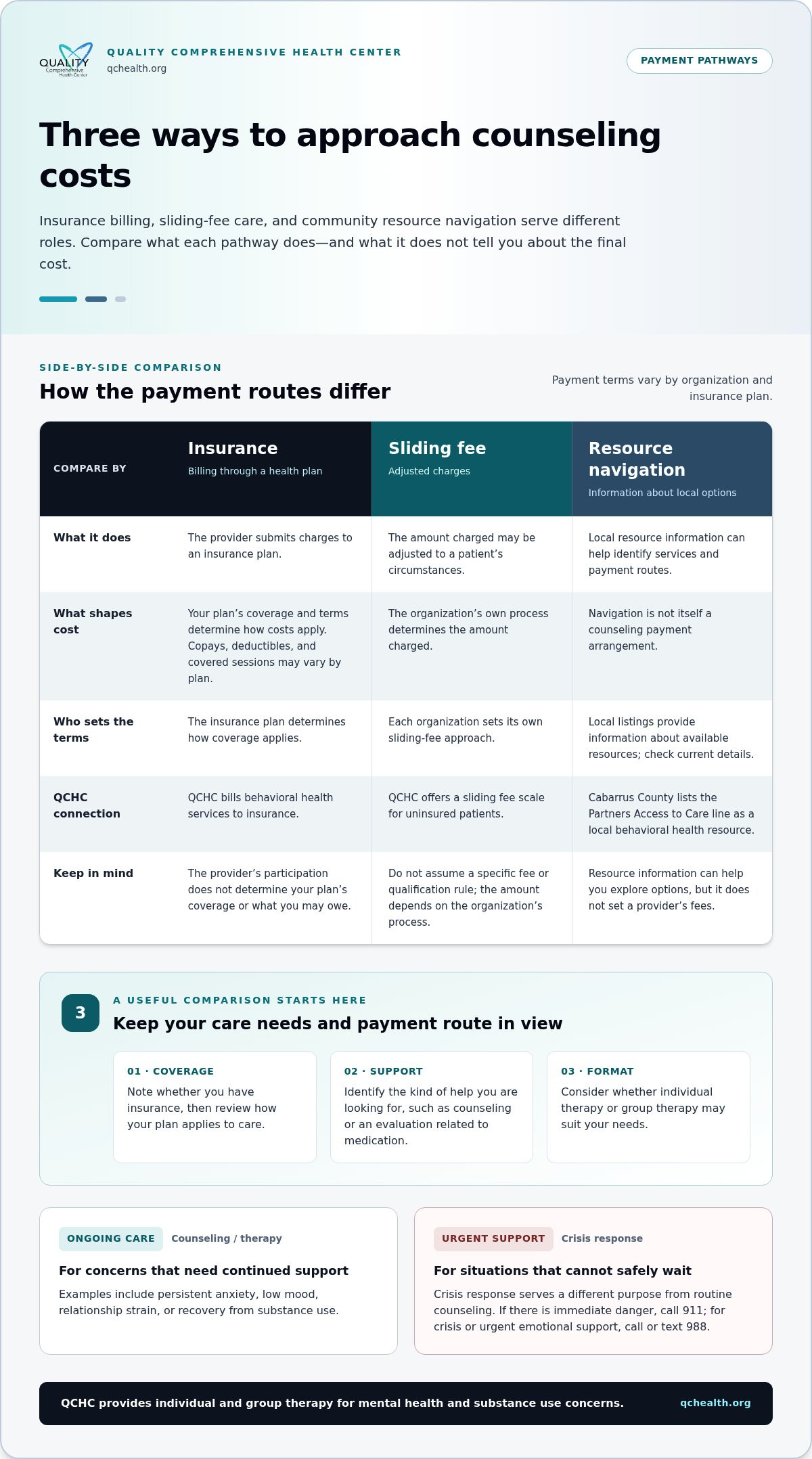
Cost can shape whether counseling feels possible, but the payment route isn't the same everywhere. Some providers bill insurance; others offer reduced-fee options, and community resources can help people locate support. Comparing these pathways makes affordable mental health services Kannapolis searches more practical. Focus on how care is paid for, not just the service name.
Insurance billing: The provider submits charges to an insurance plan. What the patient pays depends on the plan’s coverage and terms.
Sliding-fee care: The amount charged may be adjusted to a patient's circumstances. Each organization sets its own approach.
Community resource navigation: Local resource information can help people identify services and payment routes. It is not itself a counseling payment arrangement.
How does a sliding fee scale support uninsured patients?
A sliding fee scale is a payment approach that can adjust charges to a patient's circumstances, rather than applying one fixed amount to everyone. Quality Comprehensive Health Center offers a sliding fee scale for uninsured patients. This can be a useful payment pathway if you don’t have insurance. The amount charged depends on the organization’s process, so avoid assuming a specific fee or qualification rule.
Reduced-fee care may help make ongoing counseling more manageable, but the term doesn't mean every patient pays the same amount or that a specific fee is guaranteed. The Jed Foundation outlines different ways to access affordable mental health care, including community-based options. As you compare, distinguish a sliding-fee arrangement from insurance billing and consider which payment pathway fits your circumstances.
What should you understand about insurance billing?
Insurance billing means a provider bills an insurer for care. Your plan determines how coverage applies, so the amount you may owe and the services covered can vary. QCHC bills behavioral health services to insurance. Your plan determines any copay, deductible, or number of covered sessions.
If you have a high deductible, consider how it may affect your out-of-pocket costs before choosing a care pathway. This guide to how to get medical care with a high deductible plan can help you think through that concern. Keep your plan details handy and use your insurer’s current benefit information to understand your coverage.
QCHC is a Charlotte-based community nonprofit that provides individual and group therapy. To learn more about QCHC behavioral health care, review the center’s information alongside your payment options. A clear view of both can help you take a more confident next step.
Compare Mental Health Resources Around Kannapolis and Cabarrus County
A resource list is most useful when it helps you decide what to do next. Rather than ranking organizations, compare the kind of help each resource represents: ongoing counseling, community-based health care, a directory of options, or crisis response. For people searching for affordable mental health services Kannapolis, the right fit depends on the support needed and practical factors such as payment and location.
Which kind of support fits your situation?
For emotional or behavioral health concerns that need continued attention, start by looking at routine counseling information. Individual therapy offers one-to-one support, while group therapy involves working with a clinician alongside other participants. Quality Comprehensive Health Center, based in Charlotte, provides both forms of therapy for mental health and substance use disorders. Its Charlotte location is an important factor for Kannapolis residents to weigh.
If the concern is immediate safety or an acute behavioral health crisis, a routine counseling search may not be the right route. Use the crisis resource listed by Cabarrus County for urgent support. For immediate danger, call 911 or go to the nearest emergency department. Keep crisis response separate from care arranged for ongoing support.
How can you compare local resources without getting overwhelmed?
Cabarrus County’s behavioral health page and Findhelp can serve as starting points for exploring local resources. They are directories, not endorsements, and listings or contact details can change. Review current information before acting on a listing. To keep the search manageable, compare each option using the same four details.
Service type: Is it counseling, community health care, a directory, or crisis response? Does the service focus on individual or group therapy?
Payment route: Does the information describe insurance billing, a sliding-fee option, or another payment pathway? Terms can vary by organization.
Location: Where is the service based, and does that location work for you? QCHC is based in Charlotte, while other resources may be located in or near Kannapolis.
Next step: Should you review service details, explore payment information, or use an urgent crisis resource?
For example, if you want ongoing therapy and need a reduced-fee route, compare counseling services and their payment information. If you’re facing an urgent safety concern, move directly to crisis support instead of spending time comparing routine appointments. That distinction helps you focus on what matters now.
Mental health support and wellness guidance can also help you reflect on the kind of support you’re seeking. For those looking to address emotional well-being and personal growth, exploring professional therapy and coaching services can help clarify the type of guidance you need. Write down the service type, payment route, location, and next step for a few relevant resources. A short comparison is often easier to act on than a long, unorganized list.
A Practical Plan for Finding Affordable Mental Health Care Near Kannapolis
A focused plan can turn a broad search into a manageable decision. For affordable mental health services Kannapolis, work through four questions: what support do you need, how might you pay, where can you access care, and what is one reasonable next step? You don't need to solve every detail at once. Start with the information you have.
Identify the kind of support you want. Write down the main concern you’d like help with, such as stress, anxiety, low mood, or substance use. Consider whether individual counseling or a group setting seems like a better fit. If you’re seeking a psychiatric evaluation or urgent crisis support rather than ongoing therapy, make that distinction before comparing routine counseling options.
Review your payment pathway. Note whether you have insurance and, if so, which plan. If you’re uninsured, look for organizations that describe a sliding-fee option. These are separate routes, and details depend on the organization and, for insurance, the terms of your plan. Don’t assume a particular cost or coverage level from a general listing.
Compare locations and access. Check where each service is based and whether getting there is practical for you. A resource serving the broader region may not be located in Kannapolis. For example, Quality Comprehensive Health Center is based in Charlotte. Consider location alongside service type and payment route, rather than relying on a provider name alone.
Choose one next step. That might mean reviewing a service’s information, looking at your insurance benefits, or using a county resource directory to continue your search. Keep the step small and specific. If your concern involves immediate danger, use urgent crisis support instead of waiting on a routine counseling pathway.
What information can help you plan for a first counseling conversation?
A short note can help you explain what you’re looking for, but preparation isn’t a requirement for receiving care. List the concerns you want to discuss, whether you prefer individual or group counseling, and any questions about payment. If you plan to use insurance, have your plan information available while reviewing coverage. It’s fine if your needs aren’t fully clear yet.
What if affordability still feels like a barrier?
Separate the options you’re considering: insurance billing applies through a plan’s terms, while QCHC offers a sliding-fee scale for uninsured patients. The amount charged depends on the applicable payment process. For broader local navigation, use Cabarrus County’s behavioral health resources and directories, keeping those listings distinct from QCHC’s Charlotte-based services.
When you’re ready to explore QCHC’s counseling and therapy information, review QCHC behavioral health care as one possible next step in your search.
QCHC Behavioral Health Care: A Community-Based Next Step
Affordable mental health services Kannapolis searches can include care options based outside the city, so location matters alongside service type and payment pathway. Quality Comprehensive Health Center (QCHC) is based in Charlotte. It’s a community-based nonprofit with more than 20 years of experience serving underserved populations. For readers comparing regional options, QCHC provides individual and group therapy focused on mental health and substance use concerns.
What behavioral health support does QCHC provide?
QCHC provides individual and group therapy focused on mental health and substance use disorders. Individual therapy offers a one-to-one setting with a licensed clinical social worker or counselor. Group therapy brings people together for clinician-led support. The right format depends on the kind of setting a person is seeking; neither format should be assumed to fit everyone.
Care is provided by licensed clinical social workers and counselors. QCHC’s community-based mission centers people who may face barriers to care, with a focus on respectful, human support. The services described here are counseling and therapy for mental health and substance use concerns. They are distinct from emergency crisis response.
How can Kannapolis-area readers take a next step?
Begin with the practical details that shape your decision. QCHC is in Charlotte, so consider the location as you review its services from Kannapolis. The center bills services to insurance and offers a sliding fee scale for uninsured patients. These are separate payment pathways, and insurance terms and sliding-fee amounts determine how they apply.
As you consider this option, keep your needs in view: whether you’re looking for individual or group therapy, whether your concern relates to mental health or substance use, and which payment route is relevant to you. You can then compare those details with other resources serving the broader region. QCHC’s Charlotte location is an important part of that comparison.
Seeking support is a meaningful step, even if you’re still working out what kind of care fits. Explore QCHC’s behavioral health information to learn more about its counseling and therapy services and payment pathways. Explore QCHC behavioral health services.
Take One Clear Step Toward Support
You don’t have to solve every part of your search today. Choose one action that feels manageable: write down what you hope to get help with, review the payment route that may fit, or compare the locations of a few options. Small steps can make a difficult decision feel more within reach.
If you’re considering affordable mental health services Kannapolis, let your needs guide the next move, not pressure to find a perfect answer right away. QCHC’s community-based approach and behavioral health team offer one place to learn more as you weigh your choices. Its Charlotte location is an important part of deciding whether its services fit your circumstances.
Explore the care information at your own pace, and take the next step when you feel ready. Explore QCHC’s behavioral health services. Support is worth seeking, and you deserve to approach that search with care and hope.
Frequently Asked Questions
How can I find affordable mental health services near Kannapolis?
Start by matching the resource to your need, then compare location and payment information. For affordable mental health services Kannapolis, search Cabarrus County and Findhelp listings with a specific phrase, such as “individual counseling” or “substance use support.” QCHC is based in Charlotte and offers individual and group therapy. If you’re considering care there, include the Charlotte location in your travel planning.
Does QCHC offer a sliding fee scale for uninsured patients?
Yes. QCHC offers a sliding fee scale for uninsured patients, and behavioral health services are billed to insurance. The amount charged through the sliding scale depends on the applicable process. If you’re uninsured, note that payment pathway as you consider care and plan your next step.
What is the difference between counseling and psychiatric services?
Counseling offers structured conversations and support, while psychiatric care can include clinical evaluation and medication management. These are different types of care, and the right starting point depends on what you’re seeking help with. QCHC’s behavioral health services include individual and group therapy provided by licensed clinical social workers and counselors. If you’re uncertain which kind of support fits, describe your main concern to a healthcare professional.
Can I use health insurance for mental health counseling at QCHC?
QCHC bills behavioral health services to insurance, but your plan determines how coverage applies. Before planning, check your insurer’s current benefit information for behavioral health, including any deductible or cost-sharing that may apply. Keep your insurance details handy when reviewing care options. If you’re uninsured, QCHC also offers a sliding-fee pathway, which is separate from insurance billing.
What should I do if I need urgent mental health help in Cabarrus County?
For immediate danger, contact emergency services. For behavioral health crisis support in Cabarrus County, the county resource page lists Partners’ Access to Care Call Center at 1-888-235-HOPE (4673). The county says staff can connect callers with services, including appointments, nearby clinics, or a crisis professional. This is an urgent support pathway, not a substitute for arranging routine counseling for ongoing concerns.
Is group therapy an option for affordable mental health support?
Group therapy is one format QCHC provides, alongside individual therapy. It may suit someone who wants a group setting for support, while individual sessions offer one-to-one time with a clinician. The best fit depends on your needs and the service’s scope. Consider your preference for group or individual support as you explore QCHC’s behavioral health services.



Comments