


Understanding My Prescription Instructions, Including SPH and CYL

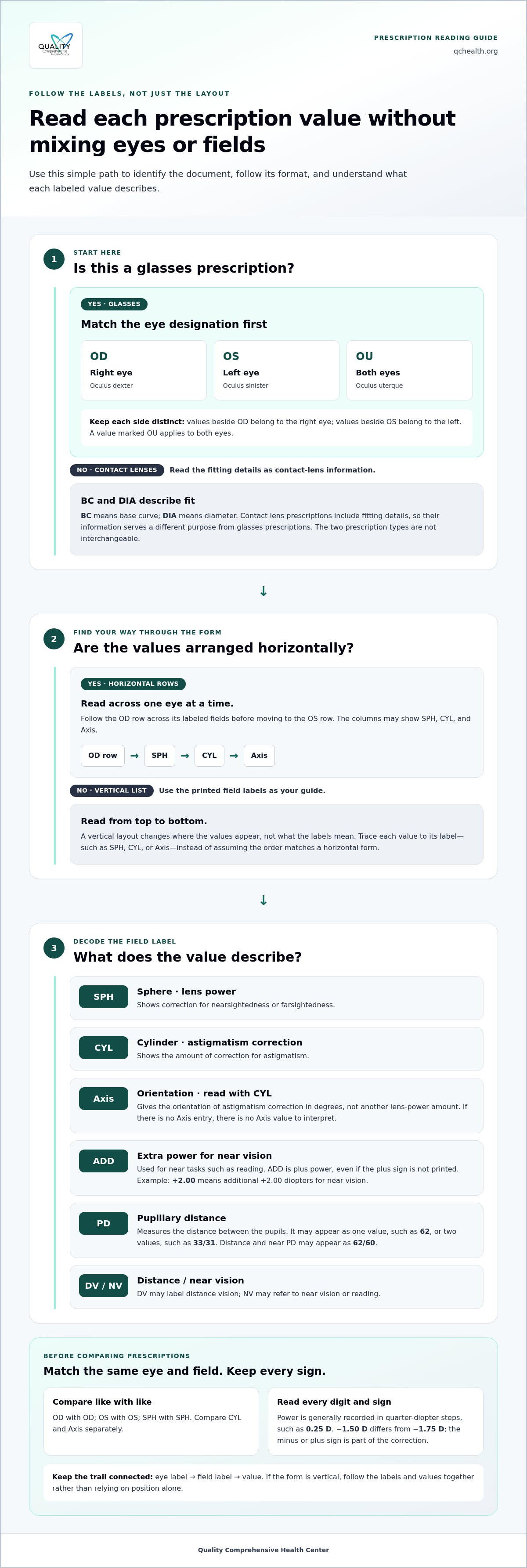
OD means your right eye, and OS means your left. When understanding my prescription instructions, start by matching those labels to each eye. Then read the prescription fields: SPH shows lens power for nearsightedness or farsightedness, while CYL shows the amount of astigmatism correction. Values appear in rows or columns, depending on the prescription format.
It’s understandable if the letters and numbers seem difficult to interpret at first. Once you know what each label means, the prescription is easier to follow. This guide explains right- and left-eye abbreviations, how to read rows and columns, and what SPH and CYL tell you about vision correction.
Table of Contents
Right-eye and left-eye abbreviations
Eye prescriptions use short labels to distinguish each eye’s correction. Recognizing them helps you connect the listed lens power with the right eye, left eye, or both.
Beyond OD, OS, and OU, common prescription abbreviations describe specific measurements. SPH means sphere, the lens power for nearsightedness or farsightedness. CYL means cylinder, the amount of correction for astigmatism. Axis gives the orientation of that astigmatism correction, in degrees from 1 to 180. ADD refers to extra power for near vision, such as reading, while PD measures the distance between the pupils.
OD and OS Designations
OD means the right eye, from the Latin oculus dexter, and OS means the left eye, from oculus sinister. On a glasses prescription, these labels show which eye each set of values belongs to.
For example, a prescription may show OD with one SPH value and OS with another. Read each label before comparing lens power: the right eye’s values don’t automatically apply to the left eye. Keeping the two sides distinct helps you understand the correction prescribed for each eye.
OU for Both Eyes
OU means both eyes, from the Latin oculus uterque. A value marked OU applies to the right and left eyes together, rather than identifying just one side.
This shared label can make a prescription more concise when the same instruction applies to both eyes. Still, check whether the values appear beside OU or separately under OD and OS. Their placement shows whether an instruction is shared or assigned to each eye individually.
Use the abbreviations as a map through the prescription. First, identify OD, OS, or OU. Then connect nearby values to their labels, such as SPH, CYL, or ADD. For instance, a CYL entry describes astigmatism correction, while its axis specifies the correction’s orientation. If there’s no axis entry, there’s no axis value to interpret.
Prescription abbreviations can vary by document type. A contact lens prescription includes fitting details such as BC for base curve and DIA for diameter. These measurements serve a different purpose from the vision-correction values on a glasses prescription. Keep the document type in mind when reading a label, especially when comparing contact lens and glasses prescriptions.
These terms explain how written instructions are organized, not the full picture of eye health. Reading OD, OS, and OU correctly helps you identify which eye each value refers to. SPH, CYL, and related fields describe the correction details.
On an eyeglasses prescription, the punctuated forms O.D. and O.S. identify the right and left eye, respectively. The same pairing may appear without periods as OD and OS: OD still indicates the right eye, while OS indicates the left. Punctuation changes the abbreviations’ appearance, not which eye they name.
OD is also written out as Oculus Dexter on an eyeglass prescription, referring to the right eye. When scanning a prescription, match the eye label as printed before reading the values beside it. This keeps the right-eye designation distinct from the left-eye designation.
Reading prescription rows and columns
To read prescription labels, first find the eye designation, then match each value to its column label. Read across a horizontal layout or from top to bottom in a vertical one, keeping each value connected to its label.
Most glasses prescriptions group values by eye and correction type. A horizontal form may place OD and OS in separate rows, with SPH, CYL, and Axis across columns. Read one row at a time. For example, follow the OD row across before moving to the OS row for the left eye. This helps prevent mixing values between eyes.
Some U.S. prescriptions use a vertical format, listing values from top to bottom rather than left to right. The layout changes, but the labels still show what each value means. A column or line marked SPH gives sphere power; CYL identifies cylinder power, and Axis gives its orientation. Follow the printed labels, not position alone.
Prescription power is generally recorded in quarter-diopter steps, such as 0.25 D. A value like −1.50 D is different from −1.75 D, so read every digit and sign. The minus or plus sign is part of the correction, not decoration. Don’t remove it when copying a value or comparing prescriptions.
Axis appears with CYL when the prescription includes astigmatism correction. Its value is a whole number from 1 to 180 degrees. It indicates the orientation of the correction, rather than another lens-power amount. Keep the Axis value beside its CYL entry when reading or sharing the prescription.
An ADD field indicates extra lens power for near vision, such as the reading portion of bifocals. It is a plus power, even when the plus sign isn’t printed. For example, an ADD of +2.00 means additional +2.00 diopters for near vision. DV may label distance vision, while NV may refer to near vision or reading.
Some prescriptions also show PD, the distance between the pupils. It may appear as one value, such as 62, or two values, such as 33/31. A distance and near PD may be written as 62/60. Read the heading beside the numbers to understand which measurement the glasses require.
Before comparing an old prescription with a new one, match the same eye and field. Compare OD with OD, OS with OS, and SPH with SPH. Then compare CYL and Axis separately. If the form uses a vertical layout, trace each label and value together instead of assuming the order matches a horizontal prescription.
The add field lists additional lens power, such as power for the reading portion of bifocals. An eyeglass prescription for multifocal, reading, or computer glasses includes an ADD or NV value, which always has a plus sign. In the example glasses prescription, the right and left eyes each have sphere power of -5.50 diopters. Keeping each eye’s sphere entry matched to its label helps preserve the intended correction.
The axis for astigmatism is measured on a scale from 0 to 180 degrees. Prism notation uses directional abbreviations: BO means Base Out, BI means Base In, BU means Base Up, and BD or BDn means Base Down. Read these abbreviations as direction labels, and keep them associated with the prism entry when interpreting the prescription.
OD and OS eye designations
OD and OS assign each eyeglass value to a specific eye: OD is the right eye, and OS is the left. This distinction matters because the two eyes can have different lens powers or correction needs, even when one prescription covers both.
Read the designation before interpreting its neighboring values. For example, an eyeglass prescription may list −2.00 D sphere for OD and −1.00 D sphere for OS. Those figures represent separate corrections, not two options for the same eye. Mixing the rows could lead you to misunderstand which lens power belongs on each side.
Differences between OD and OS may involve sphere, cylinder, or both. Sphere relates to nearsightedness or farsightedness, while cylinder describes astigmatism correction. One eye may have a cylinder value while the other has none, or each eye may have a different cylinder amount. The axis paired with cylinder identifies the correction’s orientation.
For instance, a prescription could show a CYL value of −0.50 with an axis of 160 for one eye. Read those entries together and keep them under the correct OD or OS label. The cylinder number alone doesn’t give the full astigmatism correction; the axis completes the prescription details for that eye.
OD and OS are labels, not diagnoses. A stronger minus sphere value indicates more nearsighted correction, but the abbreviation itself only says which eye the value describes. It doesn’t identify the cause of a vision change or explain an eye health condition. Prescription values and a clinician’s assessment provide different information.
This distinction also matters when comparing prescriptions over time. Match OD with OD and OS with OS, then compare the same field, such as sphere with sphere or cylinder with cylinder. Don’t compare a change in the left eye’s sphere with the right eye’s cylinder. Keeping the eye label and field consistent makes the comparison meaningful.
Glasses and contact lenses both use eye-specific information, but their prescriptions aren’t interchangeable. Contact lenses sit directly on the eye, so their prescriptions include fitting details alongside vision correction. A contact lens fitting helps determine whether the lenses suit the wearer. OD and OS still identify which eye each contact lens entry belongs to.
If a prescription lists separate OD and OS values, treat each side as its own set of instructions. Read the eye label, then follow its sphere, cylinder, and axis entries together. This simple sequence keeps the right correction associated with the right eye and makes the prescription easier to discuss during care.
Prescription FAQs
“Prescription” can mean eyeglass instructions or medicine directions, and the terms differ. These answers address medication questions and clarify how eye-prescription language works.
Food and As-Needed Directions
“With food” means take the medicine with a meal or snack. “On an empty stomach” means follow the label’s timing instructions around meals. “As needed” means use it only for the specified symptom or situation, according to the directions.
What do these directions mean? Follow the medicine label, because food instructions and permitted use depend on the specific medicine. If the wording is unclear, ask a pharmacist to explain the prescription.
Can medicines interact with food, alcohol, vitamins, or other drugs? Yes, some combinations can affect how a medicine works or cause unwanted effects. Share your full list of medicines and supplements, along with relevant questions about food or alcohol, with a pharmacist.
Missed Doses and Pill Changes
What to do after a missed dose, or whether to change a pill’s form, depends on the medicine’s specific directions. Don’t double a dose or split, crush, or open a pill based on guesswork.
What should I do if I miss a dose? Read the medicine instructions and ask a pharmacist what to do about that specific missed dose. The right next step depends on the medicine and its schedule.
Can I split, crush, or open prescription pills? Some pills shouldn’t be altered, so ask a pharmacist before splitting, crushing, or opening yours. The label or pharmacist can clarify whether the pill can be taken that way.
What if the label conflicts with what my doctor said? Contact the prescriber or pharmacist before changing how you take the medicine. Explain the exact difference between the spoken instruction and the label.
Checking Dosage and Timing
A pharmacist can review the medicine name, prescribed amount, timing, and label directions together. Keep the container nearby and explain your question clearly.
How do I check dosage and timing? Read the label with the pharmacist and ask them to explain each dose, timing, and food instruction in plain language. Confirm what to do if you miss a dose.
How do refills work in the United States? Check the label for refill information and contact the pharmacy before running out. If it shows no refills, ask the pharmacy how to reach the prescriber for next steps.
Warnings, Side Effects, and Interactions
Warnings describe risks or precautions, while side effects are unwanted effects associated with a medicine. Details vary by prescription, so read its specific label rather than applying another medicine’s instructions.
What warnings and side effects should I know? Review the medication guide and label, then ask a pharmacist to explain listed effects and precautions. Report concerning symptoms to a healthcare professional.
What should I do after an overdose or serious reaction? Seek emergency medical help immediately and provide the medicine container or name, if available.
Eye prescriptions use different language: oculus sinister identifies the left eye, while diopters describe lens power and degrees describe an astigmatism axis. These terms apply to vision correction, not medicine dosage or timing.
SPH and CYL meanings
SPH and CYL describe different parts of an eyeglass correction. SPH, or sphere, gives lens power for nearsightedness or farsightedness. CYL, or cylinder, indicates astigmatism correction. Read each value with its sign and eye designation to understand what the prescription records. To understand my prescription instructions, start by identifying these labels before interpreting the values.
A negative SPH value indicates myopia, or nearsightedness; a positive value indicates hyperopia, or farsightedness. For example, −2.00 D means two diopters of lens power for distance correction. A prescription of −7.00 D indicates greater nearsightedness than −1.50 D. A zero-diopter SPH means no sphere correction is listed.
Sphere power is measured in diopters, written as D. The sign matters: −3.00 D and +3.00 D describe different corrections, not interchangeable strengths. A stronger negative value represents more nearsighted correction. A stronger positive value represents more farsighted correction. These numbers describe the lens power, not a complete measure of eye health.
CYL records the amount of astigmatism correction, when needed. Astigmatism involves uneven curvature that affects how light focuses. A cylindrical lens has different focusing power in meridians 90 degrees apart. CYL values also use plus or minus signs, and the number alone doesn’t show the correction’s orientation.
That orientation appears in the Axis field, measured in degrees from 1 to 180. Read CYL and Axis together. For example, a prescription with CYL −0.50 and Axis 160 combines the amount and direction of astigmatism correction. Axis isn’t an additional diopter value; it identifies the orientation for the cylinder correction. Understanding my prescription instructions also involves seeing how these linked fields work together.
Some prescriptions use plus-cylinder notation, while others use minus-cylinder notation. The same lens correction can appear in either format after the values are transposed. For example, −3.00 +1.00 × 60 and −2.00 −1.00 × 150 represent the same correction. Different-looking numbers don’t necessarily mean the prescription changed.
An eye exam measures the correction needed for clear vision, but SPH and CYL don’t describe every prescription feature. ADD can record extra near-vision power, while Prism and Base indicate a separate prism correction. Prism may help align images for someone experiencing double vision. These fields serve purposes distinct from sphere and cylinder.
Glasses and contact lenses also have different prescription details. Contact lenses sit directly on the eye and include fitting measurements, so eyeglass SPH or CYL values alone don’t describe contact lens fit. Keep the prescription type in view when reading its numbers, and discuss any unclear value during care. For help connecting vision concerns with broader health questions, explore community health support.
Quality Comprehensive Health Center: Specialty care
Quality Comprehensive Health Center provides specialty care for health needs that call for focused clinical support. Understanding SPH and CYL helps you read an eyeglass prescription, while specialty or primary care can support broader health concerns affecting your well-being.
For children and families, pediatric care provides a setting focused on children’s health. Behavioral health services can support emotional and mental well-being as part of overall health. These services address different needs, so the next step depends on the concern you want to discuss.
If prescription questions connect to a broader health concern, contact Quality Comprehensive Health Center to discuss your care needs.
Bring Your Health Questions Into Your Next Conversation
Understanding a prescription can be one part of taking an active role in your health. A little time spent understanding my prescription instructions can help me feel more prepared to raise questions and describe what I need during a healthcare conversation. Keep your questions focused on the concern you want addressed, whether it affects you or a child in your care.
Quality Comprehensive Health Center offers specialty care, primary care, and pediatric care for people seeking support with broader health needs. If those services align with the questions you’re carrying forward, contact Quality Comprehensive Health Center to explore a next step that feels right for you. Clear questions can open the door to more informed conversations and care that supports your well-being.



Comments