


Preparing for Your First Therapy Session: 2026 Guide
- QCHC Communications

- 2 hours ago
- 12 min read
What if the most courageous conversation of your life isn't a confrontation, but a quiet moment of self-advocacy? It is perfectly natural to feel a mix of hope and hesitation as you look toward your first appointment. You might worry about being judged, or perhaps you feel overwhelmed trying to find the right words to explain your feelings. We believe that every person is worthy of being heard, respected, and supported. Learning how to prepare for your first therapy session is the first step in reclaiming your narrative and finding a clear path toward mental wellness.
This 2026 guide will demystify the therapeutic process. We will walk through the practical logistics, help you prepare the right questions, and explain how we integrate behavioral health with primary care to support your whole self. From understanding our sliding fee scale to identifying your personal goals, you will find everything you need to begin your healing journey with total confidence. Your future depends on finding clarity, seeking support, and embracing growth.
Table of Contents
What to Expect: Demystifying the Initial Consultation
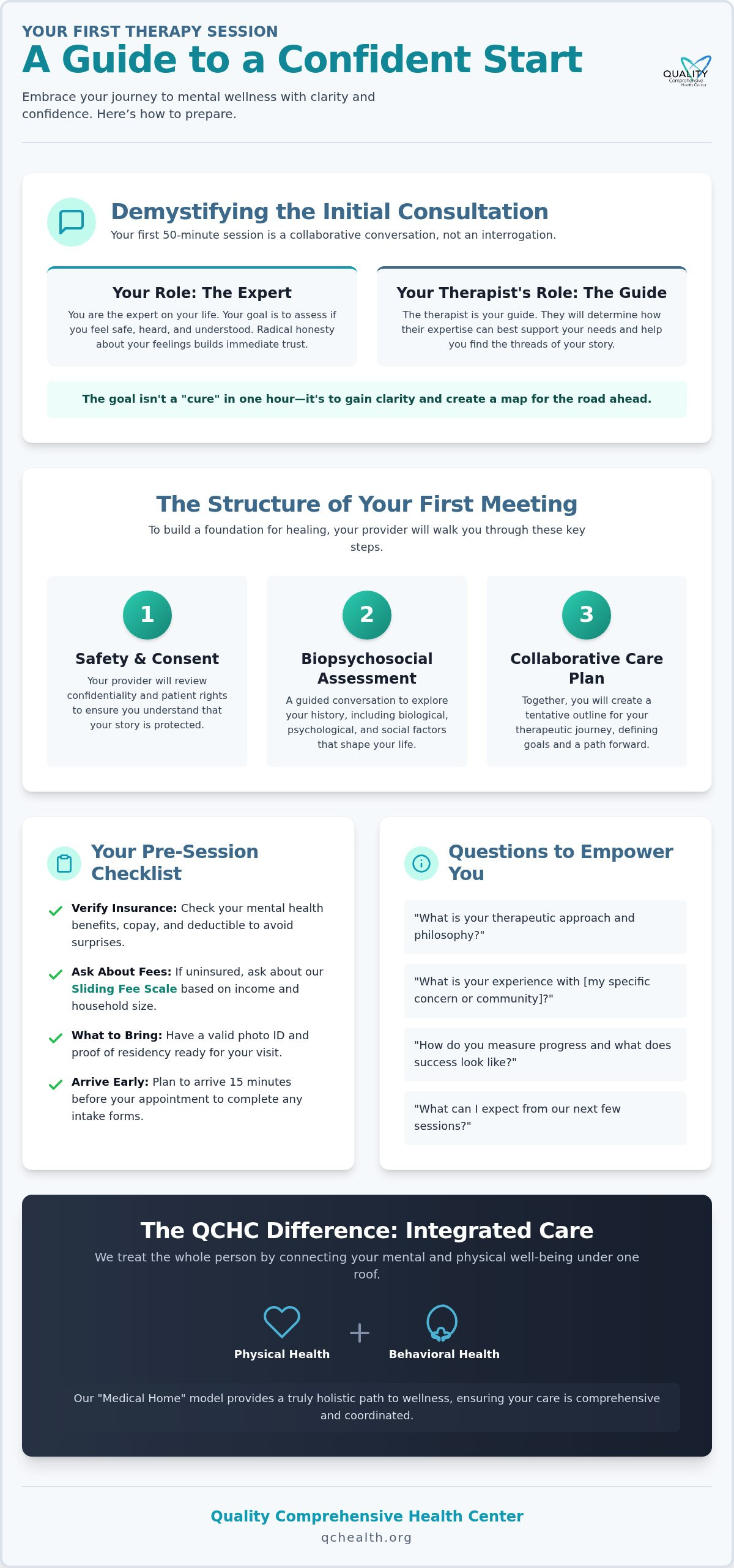
Walking into your first appointment is a brave act of self-advocacy. The first 50 minutes are a shared discovery. It isn't an interrogation; it's a conversation. While some platforms suggest the first session is just an interview, we view it as the beginning of a collaborative Care Plan. This session serves as a "fit check" for both you and your provider. You are assessing if you feel safe and heard. Meanwhile, the therapist is determining how their expertise can best support your specific needs. You are the expert on your life; they are the guide for the journey.
The Structure of the First Meeting
Before the deep emotional work begins, we establish the ground rules of your safety. Your provider will review confidentiality, consent, and your patient rights. This ensures you understand that your story stays protected. You will then engage in a Biopsychosocial Assessment. This is where the therapist explores your history, including biological factors like family health, psychological patterns, and social influences like your environment. To better understand the clinical side of these methods, you can learn more about psychotherapy and how different techniques address mental health. We define the intake session as a critical foundation for Health Equity by ensuring your specific cultural and social context directs your clinical care.
Building Immediate Trust
It's common to sit down and feel like you don't know where to start. You might feel a rush of emotions or a complete blankness. That's okay. Your therapist acts as both a professional guide and a supportive neighbor. They are trained to help you find the threads of your story. When you think about how to prepare for your first therapy session, remember that radical honesty about your current emotional state is the most powerful tool you have. Whether you are feeling anxious, numb, or hopeful, sharing those immediate feelings helps build a bridge of trust. This transparency allows your therapist to meet you exactly where you are.
Don't expect a total "cure" in the first hour. The goal is clarity. By the end of the session, you should have a basic understanding of your therapist's approach and a tentative outline for your journey. We prioritize your Worthiness throughout this process. You are taking a bold step toward healing. The intake is simply the map-making phase for the road ahead. Learning how to prepare for your first therapy session means giving yourself permission to be imperfect and authentic. We are here to listen, to validate, and to help you grow.
Navigating the Logistics: Insurance, Fees, and Access
Logistical hurdles often feel like the highest barrier to mental health support. Before you sit down with a provider, you need to know the path is clear. Start by verifying your insurance benefits. Federal regulations in 2026 require most plans to offer mental health benefits on par with medical ones. Checking your specific copay or deductible avoids surprises. If you carry a high deductible plan, you might worry about upfront costs. Learning how to get medical care with a high deductible plan helps you manage these expenses while prioritizing your wellness. We view this administrative preparation as a shared responsibility between the clinic and the community.
Financial Empowerment
We believe financial status should never dictate your access to healing. If you don't have insurance, ask our team: "Do you offer a sliding fee scale based on my income?" This tool is a cornerstone of our mission. It ensures every member of the Charlotte community can receive high-quality Behavioral health services regardless of their bank balance. We use this scale to adjust fees based on your household size and earnings. This approach lowers the barrier for first-time seekers and reflects our commitment to Health Equity. For more expert advice on the clinical side of these initial steps, you can read about how to prepare for your first therapy session from leading mental health researchers.
The State-of-the-Art Facility Experience
Preparation isn't just about money; it's about physical readiness. When you visit our modern facility on Beatties Ford Road, you will find a welcoming, judgment-free environment. It's designed to feel like a Medical Home rather than a cold clinic. To make your visit smooth, please bring a valid photo ID and proof of residency. Arriving 15 minutes early allows you to complete any digital intake forms through our patient portal. If you prefer virtual care, ensure your device is charged and you have a private space. Whether in-person or via telehealth, our goal is to make the logistics invisible so the care can take center stage. If you're ready to start, our team can help you schedule your first appointment today.
Understanding these logistics is a vital part of how to prepare for your first therapy session. It removes the "what ifs" that fuel anxiety. By gathering your documents and confirming your payment path, you clear the mental space needed for the therapeutic work. We are proud of our state-of-the-art facilities, but we are even prouder of the human connections we build inside them. Every patient is a partner in our mission to create a healthier Charlotte. Taking care of the paperwork now means you can focus entirely on your healing journey later.
Mental and Emotional Readiness: Defining Your Goals
Healing begins with a quiet reflection on your current needs. When considering how to prepare for your first therapy session, start by noticing the "signs" that prompted you to reach out. Perhaps you've felt a persistent weight in your chest, or maybe you've noticed physical symptoms like unexplained fatigue or tension that your primary care doctor couldn't fully explain. Our integrated care model recognizes that your body and mind are inseparable. Identifying these physical connections helps your therapist see the full picture of your health. Your body often speaks what your mind hasn't yet found the words to say.
Distinguish between your immediate needs and your long-term aspirations. Are you seeking immediate crisis support for a recent life event, or are you looking for a sustainable path toward long-term emotional resilience? A helpful framework is the "Magic Wand" exercise. If you woke up tomorrow and your primary struggle was gone, what would be different? Would you feel more present with your family? Would you have the energy to engage with your community again? Defining these outcomes gives your journey a clear destination and ensures your Care Plan is built around your specific vision of success.
Preparing Your Narrative
You don't need to have a perfect script, but drafting a brief "history of the problem" can save valuable time during your intake. Note when your symptoms started and what makes them better or worse. Equally important is identifying your strengths and community support systems. Whether it's a supportive church group, a close friend, or a personal hobby, these are the tools we'll use to build your resilience. For a deeper look at local resources, you can explore our guide on a mental health check-in Charlotte residents can use to find balance and strength.
Managing Pre-Session Anxiety
It's completely normal to feel "therapy jitters" before your first appointment. These feelings aren't a sign of weakness; they're a sign of courage and growth. You're stepping into the unknown to better yourself. If you feel overwhelmed in the waiting room, try a simple grounding technique. Focus on five things you can see, four you can touch, and three you can hear. This pulls your mind out of future worries and back into the present moment. Remember, you are the expert on your own life experience. Your therapist is there to listen and learn from you, not to judge or critique your story. Preparing your heart is a vital part of how to prepare for your first therapy session, ensuring you walk through our doors feeling empowered and ready for change.
The First Session Checklist: Questions for Your Therapist
Empowerment begins with asking the right questions. You aren't just a patient receiving a service; you are an active partner in a collaborative Care Plan. When you consider how to prepare for your first therapy session, think of it as a mutual interview. You deserve a provider who understands your history, respects your culture, and values your unique perspective. This checklist helps you move beyond the surface and ensures your chosen therapist is the right fit for your long-term wellness.
"What is your experience working with my specific community or background?" Lived experience and cultural awareness are vital for building a bridge of trust.
"Which therapeutic modalities do you specialize in?" Inquire if they use Cognitive Behavioral Therapy (CBT), trauma-informed care, or other evidence-based approaches.
"How do you integrate physical health concerns into your treatment?" Your mental and physical health are inseparable parts of a whole.
"What does a typical session look like, and how often will we meet?" Clarity on frequency and duration helps you plan for consistent growth.
Vetting for Cultural Competence
You have a fundamental right to an affirming, judgment-free environment. Ask your provider: "How do you approach cultural differences in the therapy room?" A principled advocate will welcome this question. They should be able to explain how they address systemic barriers and marginalized experiences with deep-seated community empathy. This transparency ensures that your identity is celebrated rather than just managed. Your therapist should feel like a supportive neighbor who possesses professional medical authority. Coordinating with your primary doctor is important for your health because it ensures your entire care team is aligned on your physical and emotional needs.
Collaborative Care Planning
Healing is a journey with a destination. Ask: "How will we know if I am making progress toward my goals?" Your therapist should offer a clear method for tracking your growth. In our Medical Home model, we go beyond the therapy room by offering on-site case management and social services. This holistic approach is why why your primary doctor is important for your health when building a sustainable wellness plan. We believe in treating the person, not just the symptom. If you are ready to take this collaborative step, contact our Behavioral health services team to schedule your initial consultation today.
Taking the time to vet your provider is a critical part of how to prepare for your first therapy session. It transforms a clinical appointment into a powerful act of civic participation and self-worth. You are investing in your future. By asking these questions, you ensure that your investment leads to the breakthrough you deserve. We are here to answer every question with honesty and respect because your health is our shared responsibility.
The QCHC Difference: Integrated Care for Charlotte
We believe that your mental health is as vital as your heartbeat. Our Medical Home model is designed to treat the whole person. We don't just manage symptoms; we support lives. By housing your doctor and therapist under one roof on Beatties Ford Road, we ensure that your care is coordinated and seamless. This integrated approach leads to better mental health outcomes because it addresses the biological, social, and psychological factors of your life together. Modern care. Human compassion.
For over 20 years, QCHC has remained committed to eliminating health disparities in Charlotte. We are a foundational civic pillar in the community. Transitioning from your first session to a long-term wellness plan is easier when your entire support system is in one place. You aren't just another appointment. You're a member of our community. Our state-of-the-art facility is a place where every person is treated with dignity and respect. We prioritize your Health Equity in every interaction.
Whole-Person Support
Our Licensed Clinical Social Workers work side-by-side with our primary care and pediatric teams. This collaboration allows for immediate interventions and holistic Care Plans. If your therapist identifies a need for specialty care, our on-site pharmacy and medical providers are ready to assist. We view mental health as a shared community responsibility. By integrating these services, we empower you to take charge of your wellness. You won't have to navigate multiple disconnected clinics alone. We lower the barriers to healthcare by sounding like a supportive neighbor rather than a detached institution.
Your First Step in Charlotte
Taking the first step is a brave act of self-advocacy. When you're ready, scheduling your first appointment is a simple and welcoming process. To make the most of your time, remember how to prepare for your first therapy session by gathering a few essentials before you arrive. Please bring a current list of all medications you are taking. Include previous medical records if you have them available. Don't forget that list of questions you've prepared for your provider to ensure you feel heard and respected.
A current list of all medications and dosages.
Previous mental health or medical records.
Your list of questions for the therapist.
Photo ID and residency documents.
Your healing journey is a collective effort. We're proud of our modern facilities, but our true strength is the human connection we build every day. We are here to listen, to validate, and to lead you toward a better future. Your Worthiness is the foundation of everything we do. Begin your journey toward wellness-schedule a behavioral health consultation at QCHC today.
Embrace Your Journey Toward Wellness
You now possess the clarity and confidence to begin your healing journey. We've navigated the intake process together, defined your emotional goals, and reviewed the essential questions for your provider. Understanding how to prepare for your first therapy session is more than a checklist; it's a powerful act of self-advocacy that prioritizes your peace of mind. Your path to wellness is no longer a mystery, but a clear road ahead.
Quality Comprehensive Health Center brings over 20 years of dedicated community service to Charlotte, NC. Our Integrated Primary and Behavioral Health care model ensures you receive holistic support in a Medical Home that values your whole self. We remain committed to Health Equity, offering an accessible sliding fee scale for all our uninsured neighbors. You don't have to navigate this alone. Take the first step toward a healthier you-book your therapy session at Quality Comprehensive Health Center. Your future is built on the courageous steps you take today, and we're honored to walk beside you.
Frequently Asked Questions
How do I know if I actually need therapy?
Therapy is a valuable tool for anyone whose emotional state interferes with daily life, relationships, or work. If you feel persistent sadness, anxiety, or overwhelm, it is a sign to seek support. You don't need to be in a crisis to reach out. Many neighbors seek a mental health check-in to build resilience before problems escalate. We believe every person is worthy of support. It's about finding clarity and improving your quality of life.
What if I don’t like my therapist after the first session?
You have the right to request a different provider if you don't feel a strong connection. The therapeutic relationship is built on trust and mutual respect. It's common to try a few sessions or different practitioners to find the right fit. We view the first meeting as a collaborative fit check. If it doesn't feel right, we'll help you transition to another professional within our network who better aligns with your specific needs.
Is therapy confidential even if I use a sliding fee scale?
Yes, your confidentiality is protected by law regardless of how you pay for your care. Your privacy is a fundamental principle of our service standards. Whether you use private insurance or our sliding fee scale, your records are secure. We follow strict federal and state guidelines to ensure your information remains private. This standard applies to all Behavioral health services. We prioritize your safety and trust above all else in our Medical Home.
Can I talk to my therapist about my physical health issues?
Absolutely, and we encourage you to discuss how your body feels during your sessions. Physical symptoms like chronic pain, fatigue, or tension are often linked to emotional well-being. Part of learning how to prepare for your first therapy session is identifying these physical markers. Our integrated model allows your therapist to coordinate with your primary care doctor. This ensures we treat the whole person rather than just isolated symptoms for better health outcomes.
How much does a first therapy session cost in Charlotte without insurance?
We use a sliding fee scale to ensure our services remain accessible to every neighbor in Charlotte. This scale is based on your household income and size, which lowers the barrier to high-quality healthcare. While private clinic rates in the city can vary significantly, our mission is to provide affordable care to the underserved. You can discuss your specific situation with our administrative team during the intake process to find a payment plan that works for you.
What is the difference between a counselor and a social worker?
Both professionals provide high-quality therapy, but their focus areas differ slightly. Counselors often focus on specific clinical techniques for mental health disorders. Licensed Clinical Social Workers (LCSWs) are trained to look at the individual within their broader social environment. They often assist with community resources, housing, or advocacy. At QCHC, both types of providers work together to ensure you receive comprehensive, whole-person support. We value the unique perspective each professional brings to your journey.
How long does a typical therapy session last?
A standard therapy session typically lasts about 50 minutes. This timeframe is often called a therapeutic hour. It provides enough time to dive into meaningful conversation while ensuring you don't feel emotionally exhausted. When you are figuring out how to prepare for your first therapy session, plan for about an hour of focused time. The first intake session might take slightly longer to cover necessary paperwork and your comprehensive history. We respect your time and your commitment.
Can I bring a family member to my first session for support?
Yes, you can bring a trusted family member or friend to your initial appointment for emotional support. Having a supportive neighbor or loved one can help ease the anxiety of a first visit. They can assist with the intake process or help you remember important details about your history. However, your therapist will likely spend some time speaking with you privately. This ensures you have a safe space to share your personal thoughts, goals, and feelings.


Comments