
Overcoming the Stigma of Mental Healthcare in the Charlotte Community
- QCHC Communications

- 4 days ago
- 12 min read
Updated: 3 days ago
What if we treated a heavy heart or a clouded mind with the same urgency and neighborly care as a physical injury? For many in our Charlotte community, the fear of being labeled unstable or the belief that mental struggles signal a personal weakness often leads to a lonely, silent battle. You might worry about what your family will think or feel a natural distrust toward medical institutions that haven't always listened. It's okay to feel this way. Your concerns are valid, and your experiences matter.
By overcoming the stigma of mental healthcare, we transform our shared vulnerability into a source of community strength. You deserve to feel whole, supported, and heard. This guide will show you how to break down barriers of shame to access the compassionate mental health Support you deserve. We will provide practical ways to talk to your family, validate your journey, and introduce you to a safe, judgment-free place for Care right here on Beatties Ford Road. Seeking help isn't about admitting defeat. It's about reclaiming your health, honoring your worth, and building a resilient future for everyone.
Table of Contents
What is Mental Health Stigma and How Does It Affect Charlotte?
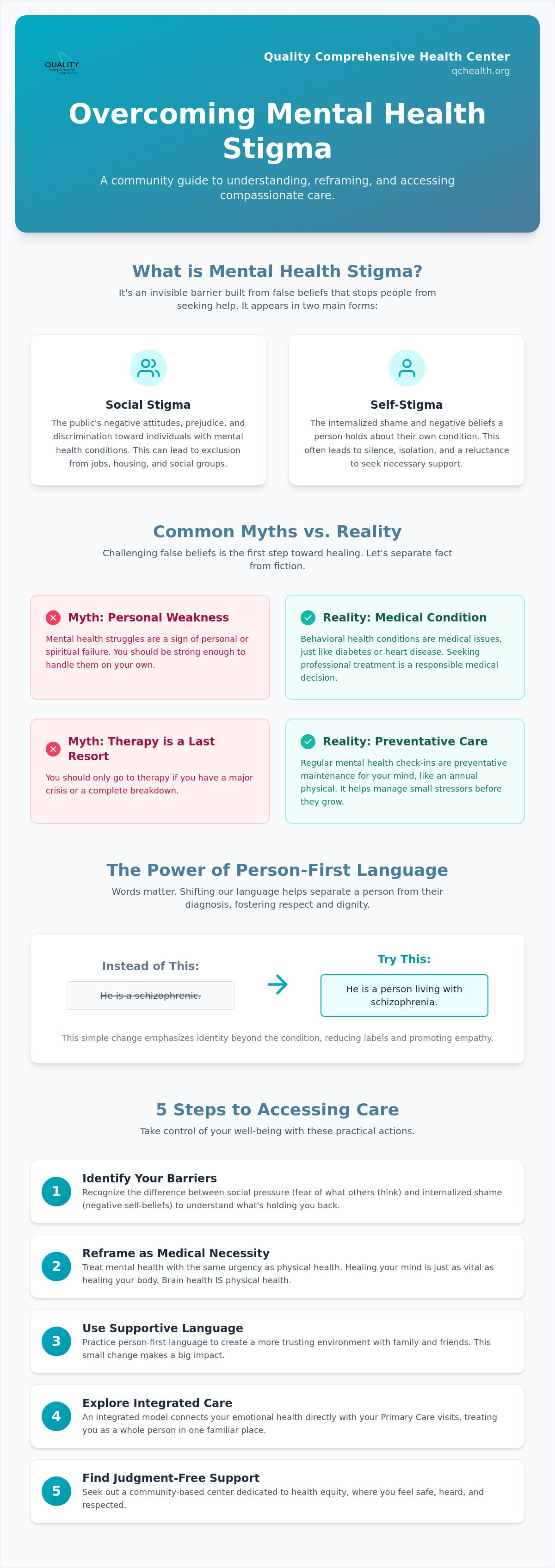
Stigma isn't just a collection of mean words or misunderstandings. It's a heavy, invisible barrier built from false beliefs and negative attitudes that stop people from living their fullest lives. In our Charlotte neighborhoods, this wall keeps many of our neighbors from seeking the help they need. To begin understanding mental health, we must first recognize how stigma operates. It usually shows up as Social Stigma, which is the public's negative reaction to mental struggles, or Self-Stigma, which is the internalized shame a person feels about their own condition. Both are equally damaging to our community's collective well-being.
Overcoming the stigma of mental healthcare is a vital step toward true health equity. In many parts of Charlotte, mental struggles are unfairly viewed as a sign of weakness rather than a medical reality. This creates a Formal Principle of our mission: we must treat mental health with the same urgency, respect, and clinical precision as physical health. Healing the mind is just as essential as healing the body.
To better understand the weight of these labels and how to move past them, watch this helpful video:
The Reality of Discrimination in Healthcare
Discrimination often hides in plain sight. It might look like a subtle avoidance from peers or direct negative comments from family members. These experiences don't just hurt feelings; they block access to jobs, stable housing, and quality medical attention. Discrimination in mental health is the systemic exclusion of individuals from essential community resources based on the false perception that they are unstable or less capable. When people fear these consequences, they stay silent. This silence only makes the struggles harder to manage over time.
Breaking the Silence on Beatties Ford Road
For over 20 years, we've worked to dismantle these barriers from our facility on Beatties Ford Road. We believe that a community-based center should feel like a medical home, not a detached institution. Local representation in healthcare leadership is a powerful tool for building trust. When you see your own community reflected in the doctors and advocates helping you, the fear of judgment begins to fade. We are committed to fostering a legacy of Empowerment where every neighbor feels safe enough to speak their truth and receive the Care they deserve.
Common Myths vs. Reality: Why Seeking Support is a Strength
Many of us grew up hearing that we should handle our problems alone. We were told that "what happens in this house stays in this house." This "tough it out" culture often makes people feel that mental struggles are a sign of spiritual or personal failure. But this belief is a dangerous myth. In reality, behavioral health conditions are medical issues that respond to professional treatment. Just as you'd see a doctor for a broken bone or diabetes, seeing a professional for emotional distress is a responsible medical decision. We all have a role to play to reduce mental health stigma by acknowledging that brain health is part of our overall physical health.
Another common misconception is that therapy is a last resort reserved for an immediate crisis. While crisis intervention is vital, regular mental health care is actually a form of preventative maintenance. It's like monitoring your blood pressure or getting an annual physical. You don't wait for a heart attack to start caring for your heart. Similarly, you shouldn't wait for a total breakdown to care for your mind. A Mental health check-in Charlotte helps you catch small stressors before they become overwhelming obstacles.
Redefining 'Strength' in Our Community
True strength isn't about suffering in silence. It's about having the courage to speak up. When you choose empowerment over shame, you set a new standard for your family and neighbors. Seeking counseling isn't just about your own peace; it's a commitment to your family's long-term well-being. It breaks cycles of generational trauma. It shows your children that their feelings are valid and manageable. Overcoming the stigma of mental healthcare starts with one brave conversation that changes the legacy of your household.
The Science of Behavioral Health
Your brain is an organ. Like any other organ, it can experience chemical imbalances or respond to environmental stress. Using the term "Mental Health Condition" rather than "Mental Illness" often feels more accurate and less heavy for many of our neighbors. Chronic stress and anxiety aren't just "in your head." They affect your sleep, your heart rate, and your immune system. Professional medical evaluations are necessary to understand these physical connections. Our team offers behavioral health services that look at you as a whole person, ensuring your care is both modern and deeply human.
The Power of Language and Community Advocacy
Language serves as the foundation of trust in any community. In our Charlotte neighborhoods, the way we discuss well-being at the kitchen table determines whether someone feels safe enough to ask for help. Words are never neutral. They either build a bridge to professional Support or reinforce a wall of silence. When we use labels that define people by their struggles, we unintentionally push them further into isolation. We believe that overcoming the stigma of mental illness requires a deliberate shift in how we speak to one another. By choosing our words carefully, we are actively overcoming the stigma of mental healthcare within our own households and social circles.
Health is a shared responsibility. It's not just about an individual appointment or a single prescription. It's about a collective effort to change the neighborhood narrative around wellness. When one person heals, the whole community grows stronger. This mission-driven approach ensures that no one has to carry their burden alone. We aren't just providing clinical services; we're advocating for a culture where every neighbor feels valued and understood.
Words That Empower
Empowerment begins with the vocabulary we use every day. We must move away from stigmatizing slang and toward terminology that is clinical, warm, and respectful. This means prioritizing person-first language. For example, instead of labeling someone as "a schizophrenic," we should describe them as "a person living with schizophrenia." This simple shift centers the human being rather than the diagnosis. Talking to children about emotions early on is also vital. When we teach the next generation that it's okay to feel overwhelmed, we give them the tools to navigate life with resilience. We're not just changing words; we're changing lives.
Advocating for Your Neighbors
Advocacy doesn't always happen in a courtroom or a government office. It happens at the grocery store, the barbershop, and the local park. It means gently intervening when you hear someone make a disparaging remark about mental health. You don't need to be an expert to make a difference. Simply sharing stories of healing can provide aspirational and grounded hope for those who are still struggling in silence. Cultural integration in healthcare is another powerful tool. When medical settings reflect the vibrant character of the people they serve, the barriers to entry begin to crumble. We are proud to be a foundational civic pillar that stands for inclusivity and Compassion in every interaction.
Practical Steps to Overcoming Stigma and Accessing Care
Taking action is the most powerful way to reclaim your narrative. Fear often grows in the dark, but education brings it into the light. When you understand that symptoms like chronic fatigue, irritability, or persistent worry are often biological responses to stress, they feel less like personal failures. For women, these biological factors are often tied to hormonal health, and a Women’s Mental Health Specialist can provide hormone-informed, virtual care tailored to these experiences. This knowledge is a vital tool for overcoming the stigma of mental healthcare. It allows you to approach your emotional well-being with curiosity instead of shame. By learning the facts, you strip away the power of negative labels and begin to see yourself as a person deserving of Support and Care.
Your journey toward wellness doesn't have to start with a specialist. It often begins with the doctor you already know and trust. Why your primary doctor is important for your health is because they serve as the first line of defense for both your body and your mind. Be honest during your next visit. Share how you're sleeping, how your appetite has changed, or if you've been feeling overwhelmed. Choosing a "Medical Home" that offers integrated, judgment-free services ensures that your physical and behavioral health are treated as one inseparable Priority.
Navigating the First Appointment
Walking through the door for the first time is often the hardest part. You can expect a behavioral health screening, which is simply a structured conversation to help your provider understand your unique needs. It isn't a test you can pass or fail. It's a roadmap for your treatment. Don't be afraid to ask questions to ensure your counselor is a good fit. Ask about their experience with your specific concerns or how they integrate cultural values into their practice. This is your time. You are the expert on your own life, and a good provider will honor that expertise with Compassion and respect. For those seeking specialized care that prioritizes these same values, you can visit Assure Psychiatry to learn about their compassionate and culturally competent approach.
Removing Financial Barriers
We know that worry about cost can be just as heavy as the stigma itself. Quality care should never be a luxury reserved for a few. In our Charlotte community, we offer a sliding fee scale to ensure that uninsured patients receive the same high-standard care as everyone else. Integrated care also saves you time and money by addressing multiple health needs in a single location. If you're concerned about insurance, learning how to get medical care with a high deductible plan can provide the clarity you need to move forward. Financial stress shouldn't stand in the way of your peace of mind.
You don't have to wait for a crisis to start feeling better. If you're ready to prioritize your well-being in a safe, neighborly environment, explore our behavioral health services and take the first step toward a healthier, more empowered you.
QCHC: Your Neighbor in Health and Empowerment
For over 20 years, our mission has been clear: providing clinical excellence, fostering community trust, and ensuring health equity for every neighbor we serve. We believe that a zip code should never determine the quality of your medical care. At our Beatties Ford Road facility, we combine state-of-the-art technology with a human, compassionate touch that feels like home. We don't just see patients; we see families, stories, and futures. By overcoming the stigma of mental healthcare, we are actively dismantling the health disparities that have historically underserved our Charlotte community. Our leadership and practitioners take personal accountability for your well-being, offering a human face to an organization that truly cares about your socio-economic success.
Your health is a shared responsibility. When you walk through our doors, you aren't just another appointment on a calendar. You're a valued member of a collective effort toward total wellness. We are here to listen, to validate, and to support you as you move toward a vibrant, multi-faceted life. Healing the mind, supporting the family, and strengthening the community are the pillars of everything we do.
Integrated Care for the Whole Person
We've designed our services to be as seamless as possible. Our integrated care model bridges the gap between Primary Care and Behavioral health services, allowing you to manage your total health in one state-of-the-art location. This approach saves time and ensures that your providers are always on the same page regarding your records and treatment goals. We aren't just a clinic; we're a foundational civic pillar. We're committed to being a steady, reliable resource for Charlotte families, ensuring that no part of your health is ever overlooked or ignored. Your physical and emotional needs deserve equal attention and clinical precision.
Join Our Mission for Health Equity
Taking the first step is an act of courage and Worthiness. We invite you to schedule your first judgment-free consultation to see how we can support your unique journey. Our 20-year promise of Excellence and Empathy remains the anchor of our service standards. Whether you're seeking Pediatric care for your children or specialized support for yourself, we're here to lower the barriers to high-quality healthcare. We offer a sliding fee scale to ensure that financial status never stands in the way of your peace of mind. It's time to prioritize your wellness in an environment that honors your dignity. Experience compassionate, community-based care at QCHC and discover what it means to be truly seen and supported. Your health is our community's strength.
Building a Healthier, More Resilient Charlotte Together
Reclaiming your narrative starts with a single, brave conversation. We've explored how shifting our language and challenging long-standing myths can transform the well-being of our entire community. By overcoming the stigma of mental healthcare, you aren't just helping yourself; you're creating a safer, more inclusive environment for your family and neighbors to thrive. True strength lies in the courage to speak up and the wisdom to seek professional Support when life feels heavy.
For over 20 years, QCHC has served as a foundational pillar on Beatties Ford Road. Our state-of-the-art facility is designed to provide modern, compassionate Care for every member of our community. We believe that high-quality health services should be accessible to everyone, which is why we offer a sliding fee scale for uninsured patients. You don't have to carry your burdens in silence. Schedule your judgment-free mental health check-in today and take the first step toward a more empowered life. Your journey toward wellness is a testament to your Worthiness, and we are honored to walk this path beside you.
Frequently Asked Questions
Is mental health care affordable for someone without insurance in Charlotte?
Yes, quality care is within reach regardless of your insurance status. We offer a sliding fee scale for uninsured patients to ensure that cost never prevents you from receiving the support you deserve. This system adjusts the price of your visit based on your household income and size. Our goal is to eliminate financial barriers so that every neighbor in Charlotte can prioritize their well-being.
Can I see a therapist and a primary care doctor at the same location?
Yes, our Beatties Ford Road facility offers an integrated care model where you can access both services under one roof. This means your primary care doctor and behavioral health provider work together to manage your total health. Having all your records in one state-of-the-art location saves you time and ensures your care team has a complete picture of your physical and emotional needs.
What happens if I’m worried about my family finding out I’m in counseling?
Your privacy is our highest priority, and seeking help is a private medical decision protected by strict confidentiality laws. We understand that overcoming the stigma of mental healthcare can feel daunting when you're worried about family judgment. Our staff is trained to provide a safe, affirming environment where your personal journey remains between you and your provider. You are in control of your care and your story.
How do I know if my stress is just 'life' or if I need professional help?
If your stress makes it hard to sleep, eat, or maintain your relationships, it is time to seek professional support. While everyone faces life's challenges, persistent feelings of being overwhelmed or unable to cope are signs that your mind needs care. A simple screening can help determine if you would benefit from counseling or medical treatment. Don't wait for a crisis to reach out.
Are the mental health services at QCHC confidential?
Yes, all services provided at our facility are strictly confidential and protected by HIPAA regulations. We maintain the highest standards of privacy for your medical records and your conversations with counselors. Our team is dedicated to building a foundation of trust with every neighbor. You can feel confident that your information is safe while you focus on your healing and empowerment.
What is a sliding fee scale and how do I apply for it?
A sliding fee scale is a payment model that reduces the cost of care for those who are uninsured or underinsured based on their income. To apply, you simply need to provide proof of your household income during your registration process. This ensures that our high standards of care remain accessible to everyone in the Charlotte community. We are committed to making health equity a reality for all.
How does QCHC support the specific needs of the Black community in Charlotte?
We support the Black community by focusing on health equity and providing culturally competent care from our Beatties Ford Road location. For over 20 years, we've worked to build trust by having leadership and practitioners who reflect the neighborhood we serve. We address the unique social and economic factors that impact health, ensuring our services are both technologically advanced and deeply human.
What should I do if a friend is struggling but refuses to seek help due to stigma?
You can help by listening with empathy and gently sharing that mental struggles are medical conditions, not personal weaknesses. Overcoming the stigma of mental healthcare is a shared responsibility that starts with supportive conversations. Offer to help them find a safe, judgment-free place like QCHC where they can feel seen and heard. Sometimes, knowing they have a supportive neighbor makes all the difference in their decision to seek help.


Comments