


Getting a Mental Health Diagnosis in 2026: A Step-by-Step Guide to Support

Nearly 60 percent of individuals struggling with mental health challenges in 2026 never receive the treatment or support they deserve. For many in our Charlotte community, the barrier isn't a lack of Will; it's the paralyzing confusion of the medical system. You might feel overwhelmed by the thought of getting a mental health diagnosis, wondering if a label will define you or if your high-deductible plan makes care impossible. We believe that health is a shared responsibility. Reaching out is an act of courage that deserves a Compassionate response, a clear path, and a steady hand. Listen. Understand. Support.
We know you're looking for more than just a clinical code; you're looking for a roadmap to feeling like yourself again. This guide provides exactly that, walking you through the diagnostic process while addressing your concerns about costs and cultural sensitivity. You'll learn how to distinguish between Charlotte providers, how to access care through sliding fee scales, and how a diagnosis serves as a tool for Empowerment. We'll explore the clinical steps, the financial realities, and the emotional journey of finding a medical home that values your Worth. Together, we can turn uncertainty into a concrete plan for Wellness.
Table of Contents
Understanding Why Getting a Mental Health Diagnosis Matters in 2026
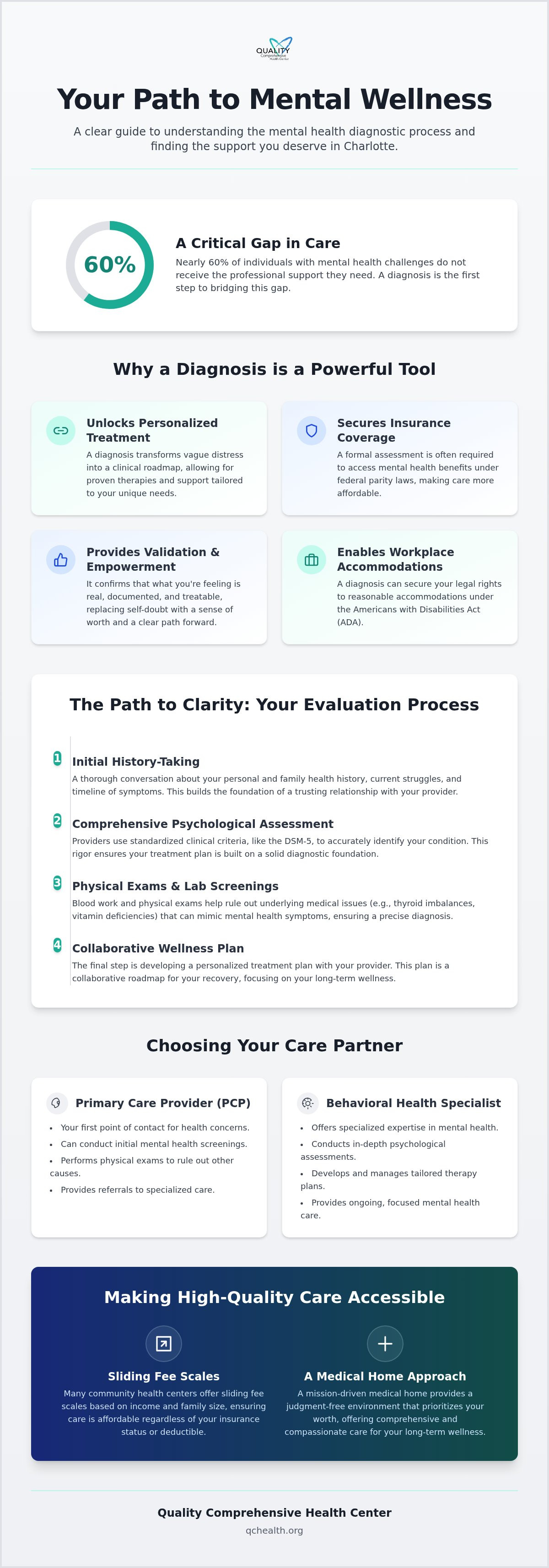
A diagnosis isn't a box that limits your potential. It's a key that unlocks the door to specific, effective care. For many in our Charlotte community, the weight of unexplained symptoms feels much heavier than any clinical label. By getting a mental health diagnosis, you transform vague distress into a concrete clinical roadmap. This clarity allows your care team to match your unique experiences with proven therapies, medication management, or specialized social support. It moves you from "getting by" to actively healing.
The sense of validation that comes with professional clarity is profound. Data from the University of St. Augustine for Health Sciences shows that over 23 percent of U.S. adults live with a mental illness. You aren't alone in this journey. A formal diagnosis proves that what you're feeling is real, documented, and treatable. It replaces self-doubt with a sense of Worth and provides a clear starting point for your recovery.
Beyond the emotional relief, there are vital practical advantages. Federal parity laws require most insurance plans to provide mental health benefits equal to medical coverage, but accessing these often requires a formal assessment. A diagnosis also secures your legal right to workplace accommodations under the ADA. This ensures your professional life stays stable while you focus on your Wellness. Early intervention is the most effective way to protect your long-term health, as nearly 50 percent of conditions begin to show symptoms by age 14.
Recognizing the Signs Within Yourself
Changes often start quietly. You might notice your sleep patterns shifting, a persistent lack of energy, or a growing desire to withdraw from friends and family. When "feeling down" begins to interfere with your job, your parenting, or your peace of mind, it's time to seek a professional perspective. Starting with a mental health check-in Charlotte helps you baseline your current state and determine if your symptoms warrant a deeper evaluation. We believe that acknowledging these signs is the first step toward Empowerment.
De-stigmatizing the Diagnostic Label
We view a diagnosis as a medical tool, much like an X-ray for a fractured bone. It identifies the specific area of need so we can begin the repair. In our medical home, we work to strip away the shame often associated with behavioral health. Getting a mental health diagnosis doesn't change your identity; it clarifies your needs. When you have clinical certainty, the anxiety of the unknown starts to fade. You shift from a place of confusion to a position of strength, supported by a community that sees your value and your potential.
The Step-by-Step Process of a Mental Health Evaluation
The path to clarity involves a series of intentional, clinical steps designed to honor your lived experience while ensuring medical accuracy. When you begin the process of getting a mental health diagnosis, your provider starts with a thorough history-taking session. They want to hear about your past, your family health history, and the specific timeline of your current struggles. This isn't just data collection; it's the foundation of a Trusting relationship. We believe in a process that is thorough, inclusive, and transparent.
Following the history-taking, the evaluation moves into a comprehensive psychological assessment. Providers utilize the Diagnostic and Statistical Manual of Mental Disorders (DSM-5) to ensure your symptoms meet specific, standardized clinical criteria. This rigor protects you from misdiagnosis and ensures your treatment plan is built on a solid foundation. Once the assessment is complete, the final step is the development of a collaborative wellness plan. Identify the cause. Validate the experience. Build the plan. Our team at Quality Comprehensive Health Center is here to guide you through every clinical and emotional milestone of this journey.
Physical Exams and Laboratory Screenings
Sometimes, the mind reflects the needs of the body. Your doctor may order laboratory screenings to check your thyroid function, vitamin D levels, or iron stores because physical imbalances often mimic behavioral health conditions. For example, an underactive thyroid can cause lethargy and low mood that looks identical to clinical depression. Blood work ensures a mental health diagnosis is clinically sound by identifying underlying biological imbalances that may be contributing to cognitive or emotional distress.
What to Expect During Your Psychological Evaluation
During the evaluation, expect a conversation that feels both personal and professional. You'll likely answer questions about your daily habits, your sleep quality, and any patterns of thought that feel intrusive or disruptive. Providers often use standardized screening tools and questionnaires to measure the intensity of your symptoms. These tools help us understand your baseline so we can track your progress over time. Your transparency is the most valuable asset in this process. Be honest, be open, and be yourself. This collaborative effort ensures that the care you receive is not only effective but also culturally sensitive to your unique background in the Charlotte community.
Comparing Your Diagnostic Options in Charlotte, NC
Choosing where to start can feel like the hardest part of the journey. In Charlotte, you have several avenues to explore when getting a mental health diagnosis, ranging from private specialist practices to community-focused health centers. The goal is to find a provider who doesn't just see a patient, but sees a neighbor. We believe that healthcare should be accessible, integrated, and deeply human. By understanding your options, you can select the path that best aligns with your personal needs and financial reality.
Many people begin with their primary care provider. These clinicians are trained to spot early warning signs and conduct initial screenings for depression, anxiety, or substance use disorders. However, if your symptoms are complex or persistent, you may need the specialized expertise of a Psychiatrist or a Licensed Clinical Social Worker (LCSW). Psychiatrists focus on the biological aspects and medication management, while LCSWs provide therapeutic interventions to help you navigate emotional and social challenges. Finding the right fit is a collaborative effort.
Primary Care vs. Specialized Behavioral Health
Starting with your primary doctor in Charlotte offers a layer of comfort and familiarity. They already know your medical history and can quickly rule out the physical mimics, like thyroid issues, that we discussed earlier. When specialized care is needed, your PCP acts as the coordinator, ensuring your referral is handled with care. This clinical communication is essential. It ensures that your therapist knows about your physical health and your doctor understands your mental wellness. Communicate. Coordinate. Care.
The Benefits of Integrated Care at QCHC
At Quality Comprehensive Health Center, we've pioneered a "Medical Home" model that places all these experts in one state-of-the-art facility on Beatties Ford Road. This integrated approach is designed to eliminate the gaps that often swallow up patients in a fragmented system. You don't have to drive across town or retell your story to five different people. We provide a space where your physical and behavioral health needs are treated as one inseparable priority.
Integrated care significantly improves diagnostic accuracy. When your primary care clinician and your behavioral health specialist can walk down the hall to discuss your case, the result is a more holistic view of your health. We prioritize your Worth by ensuring you have a consistent team that sees the whole picture. This model is especially vital for our underserved populations, as it lowers the physical and financial barriers to getting a mental health diagnosis. We are more than a clinic; we are a foundational pillar of the Charlotte community.
Overcoming Common Barriers to Mental Health Support
Seeking help is a brave choice, but the path often feels blocked by financial and social walls. For many neighbors in Charlotte, the fear of high costs or being misunderstood by a clinical institution prevents them from getting a mental health diagnosis. We believe that your bank account or your background should never dictate the quality of your care. Our mission is to lower these barriers, providing a space where excellence meets accessibility. We advocate for the underserved. We listen to the unheard. We care for the whole person.
Affordability and the Sliding Fee Scale
High out-of-pocket costs shouldn't mean delayed treatment. If you are struggling with how to get medical care with a high deductible plan, community resources offer a vital lifeline that traditional private practices may lack. We utilize a sliding fee scale to ensure that uninsured neighbors receive the same high standard of clinical attention as those with premium insurance. Our medical social workers act as your personal advocates, helping you find financial assistance and navigate the complexities of 2026 healthcare regulations. Health is a right. Care is a promise. Support is available. By centering the patient's financial reality, we ensure that obtaining a diagnosis is the start of a solution, not the start of a debt.
Finding Culturally Affirming Care
Stigma remains a powerful force in our Charlotte community, particularly when it comes to behavioral health. Many patients fear that a clinical label will bring judgment or that providers won't understand the unique pressures of their specific cultural experiences. We address this by prioritizing representation and deeply understanding the social determinants of health. This means looking at your environment, your history, and your community as part of your wellness journey.
Getting a mental health diagnosis in an environment that respects your heritage reduces the fear of being misunderstood by the medical establishment. We operate with a judgment-free philosophy that centers your Worth and respects your lived experience. Our state-of-the-art facility on Beatties Ford Road is designed to be a welcoming neighborhood pillar rather than a detached institution. We bridge the gap between clinical science and community empathy, ensuring every patient feels seen and heard. Breaking through these barriers requires a partner who is as committed to equity as they are to medicine. Contact our care team at Quality Comprehensive Health Center to learn more about our accessible behavioral health services.
Starting Your Wellness Journey with Quality Comprehensive Health Center
For over two decades, Quality Comprehensive Health Center has served as a foundational civic pillar in the Charlotte community. We believe that health is a shared responsibility, and our mission is to ensure that every neighbor has access to high-quality, integrated care. We understand that the first barrier to getting a mental health diagnosis is often the fear of being seen as a number rather than a person. At QCHC, we replace that detached clinical feel with deep-seated community empathy and professional medical authority. We are here. We are Charlotte. We are QCHC.
By choosing an integrated Medical Home, the process of getting a mental health diagnosis transitions naturally into a personalized treatment plan that addresses your physical, emotional, and social needs. You don't have to navigate this journey alone. Our state-of-the-art facility on Beatties Ford Road is designed to provide a seamless experience where your Primary Care and Behavioral Health teams work in total alignment. This collaborative model ensures that your recovery is grounded in clinical excellence and supported by a team that truly knows your history.
Our Compassionate Behavioral Health Team
Our team consists of dedicated Licensed Clinical Social Workers and behavioral health professionals who prioritize your Worth above all else. We combine technologically advanced diagnostic tools with a personally attentive style of care. The QCHC promise is simple: we provide the expertise you expect from a modern medical institution with the warmth of a supportive neighbor. When you walk through our doors, you aren't just a patient; you're a member of a community that values your Empowerment. Listen. Understand. Support. This is the rhythm of our care, ensuring that every session moves you closer to lasting Wellness.
Your First Consultation: What to Bring and Expect
Taking the first step toward professional support is an act of courage. We strive to make your initial visit as welcoming and stress-free as possible. You'll encounter a judgment-free environment where your story is heard with Compassion and Integrity. To help us provide the most accurate assessment, please prepare for your first visit by gathering a few essential items. Having these ready allows our team to focus entirely on you during your consultation.
Identification: A valid government-issued ID to help us establish your medical record.
Insurance Information: Bring your insurance cards if you have coverage; if you are uninsured, let us know so we can discuss our sliding fee scale.
Health History: A list of any current medications, past diagnoses, or specific concerns you want to address.
Questions: Any notes about your symptoms or goals for your treatment journey.
Scheduling your first appointment is the beginning of a more empowered version of yourself. Whether you visit us on Beatties Ford Road or engage with our outreach programs, you are choosing a partner dedicated to health equity and clinical excellence. Your health is our mission, and your Wellness is our community's strength.
Embrace Your Path to Lasting Wellness
A formal assessment is the clinical key that turns confusion into a structured plan for recovery. We've explored how getting a mental health diagnosis provides the validation you deserve while opening doors to essential insurance benefits and specialized therapies. By choosing an integrated care model, you ensure that your mind and body receive the collaborative attention required for true healing. You don't have to navigate the financial or social barriers of the healthcare system alone. Our community is stronger when every neighbor feels seen, heard, and supported.
For over 20 years, Quality Comprehensive Health Center has stood as a foundational pillar of health equity in Charlotte. We offer a sliding fee scale to ensure that every patient, regardless of insurance status, can access our state-of-the-art facility on Beatties Ford Road. Our mission is to provide professional excellence with a neighborly touch. Take the first step toward clarity-schedule your behavioral health consultation at QCHC today. Your Worth is our priority, and your Wellness is within reach. Together, we can build a healthier future for all.
Frequently Asked Questions
How do I know if I need a professional mental health diagnosis?
Persistent changes in your mood, sleep patterns, or social interactions that interfere with your daily responsibilities are strong indicators. If these symptoms last for more than two weeks and prevent you from working or enjoying life, seeking professional clarity is an act of Empowerment. A clinical evaluation helps determine if what you're feeling is a temporary reaction to stress or a condition that requires a structured treatment plan.
Can my primary care doctor give me a mental health diagnosis?
Yes, your primary care provider is often the first clinician to screen for and diagnose common conditions like anxiety or depression. They use standardized assessment tools during your visit to evaluate your symptoms. If your situation is complex, they will coordinate with our behavioral health specialists to ensure you receive the most accurate clinical roadmap. We believe in a collaborative approach that treats the whole person.
What is the difference between a psychiatrist and a therapist?
Psychiatrists are medical doctors who specialize in the biological aspects of mental health and can prescribe medication to manage symptoms. Therapists, such as Licensed Clinical Social Workers, focus on talk therapy and behavioral strategies to help you navigate emotional challenges. In our integrated care model, these professionals work together to ensure your treatment plan is both medically sound and personally attentive to your unique lived experience.
How much does a mental health evaluation cost in Charlotte without insurance?
Costs for getting a mental health diagnosis vary across the city, but community health centers provide vital protections for the uninsured. We use a sliding fee scale based on your household income to keep care accessible for every neighbor. Our medical social workers are available to help you find financial assistance options so that cost never becomes a barrier to your Wellness. We prioritize your health over your bank account.
What happens if I don't agree with the diagnosis I receive?
You always have the right to ask questions or seek a second opinion if a clinical label doesn't align with your experience. A diagnosis is a collaborative tool designed to guide your care, not a permanent identity that defines who you are. We encourage open, honest dialogue between you and your care team. This ensures that your treatment plan is something you feel confident and empowered to follow.
How long does the process of getting a diagnosis typically take?
The timeline depends on the complexity of your symptoms, but it usually begins with a 60 minute initial consultation. Some conditions are clear after one or two sessions, while others may require longitudinal observation or specialized testing to ensure accuracy. For more information on specialized evaluations for complex conditions like thought disorders or autism, read more. We focus on being thorough rather than rushing the process. This clinical rigor ensures that your path to recovery is built on a foundation of Trust and medical excellence.
Is my mental health diagnosis confidential?
Yes, your clinical information is protected by federal HIPAA laws and strict internal privacy protocols. We value your Trust and ensure that your health records are only shared with your explicit consent or as required by law for your safety. Maintaining a safe, private environment is a core principle of our medical home. You can speak openly with our team knowing that your privacy is a foundational priority.
Can I get a diagnosis for my child or teenager at QCHC?
Yes, we provide pediatric care and behavioral health services specifically tailored for children and adolescents in the Charlotte community. Since nearly 50 percent of mental health conditions begin by age 14, early intervention is the most effective way to protect their long-term health. Our team works closely with families who are getting a mental health diagnosis for their children, providing a supportive and culturally sensitive environment for young people to thrive.


Comments