


Comprehensive Guide to Charlotte Medical Social Worker Services (2026)

Imagine walking out of a doctor's office with a heavy diagnosis only to realize you can't afford the prescription or find a ride to your next appointment. For many in our community, the path to healing is blocked by these common life barriers. It's overwhelming to manage a chronic illness while worrying about grocery money or navigating a confusing insurance system. You deserve a healthcare experience that treats you as a neighbor, not just a medical record.
This guide explores how Charlotte medical social worker services bridge the gap between clinical care and the community resources you need to thrive. Discovering resources. Reducing costs. Restoring hope. We'll preview how these advocates help you find local food support, lower the cost of prescriptions, and provide emotional strength after a difficult diagnosis. You'll learn exactly how to access the practical help that allows your medical treatment to succeed. By connecting clinical expertise with human compassion, we ensure that every member of our community has the tools to achieve lasting wellness.
Key Takeaways
Recognize how licensed professionals address the emotional weight of a diagnosis to ensure your mental well-being remains a top priority.
Navigate insurance hurdles. Access financial aid. Secure stable housing. Use Charlotte medical social worker services to remove the obstacles that complicate your recovery.
Break through hidden barriers like cultural mistrust or digital literacy gaps that often prevent underserved populations from receiving equitable care.
Learn the exact steps to request a referral from your Primary or Specialty care provider to begin your journey toward holistic stability.
Understand the power of integrated health equity where human compassion and clinical excellence work together to serve the whole person.
Table of Contents
Understanding Medical Social Worker Services in Charlotte
Medicine provides the blueprint for recovery, but life often gets in the way of the plan. For many in Mecklenburg County, a doctor’s visit is just the beginning of a complex journey. Charlotte medical social worker services act as the vital link between your clinical diagnosis and the resources you need to actually get better. These are licensed professionals who look beyond the medical chart to see the human being. While a doctor treats the illness, a medical social worker treats the circumstances surrounding it. Understanding Medical Social Work means recognizing that health isn't just about pills; it's about stability, dignity, and access.
In North Carolina, the path to professional practice is rigorous. Candidates for licensure must complete a minimum of 3,000 hours of post-master’s paid clinical employment and 100 hours of direct supervision. This high standard ensures that when you speak with a social worker in our city, you're talking to an expert trained in navigating the specific health disparities that impact our neighborhoods. It's important to distinguish this role from clinical social work. While clinical social workers focus on providing therapy and mental health diagnoses, medical social workers specialize in Resource Navigation. They are the architects of your support system.
The Core Mission of Medical Social Work
Our mission is simple: we protect your rights while you focus on healing. Advocating for patients. Empowering families. Navigating systems. Medical social work stands as a foundational pillar of Health Equity by ensuring that every person receives the same high standard of care regardless of their background. These professionals don't just hand out phone numbers; they walk with you through the complexities of hospital discharge and long-term care planning. By centering Human Dignity, they transform a cold clinical environment into a supportive community of care.
Why Social Support is a Clinical Necessity
The data is clear: your zip code often matters as much as your genetic code. In Charlotte, Social Determinants of Health (SDOH) like housing instability and food insecurity directly impact recovery rates. If you don't have a stable place to sleep, managing a chronic disease becomes nearly impossible. Proactive social intervention is the key to breaking this cycle.
Reducing readmissions: Connecting patients to home care prevents unnecessary hospital returns.
Stabilizing housing: Secure living environments lead to better medication adherence.
Removing barriers: Transportation support ensures follow-up appointments aren't missed.
By addressing these Life Barriers early, we don't just improve your health today. We build a foundation for a healthier tomorrow for all of Mecklenburg County. Health is a shared responsibility, and medical social workers ensure that no one has to carry that burden alone.
Core Support: How Medical Social Workers Help You
When a medical crisis hits, the logistics can be as taxing as the illness itself. Charlotte medical social worker services provide the practical infrastructure needed to keep your life moving forward while you focus on recovery. Whether it's finding a reliable ride to a dialysis center or figuring out how to pay for life-saving medications, these advocates handle the heavy lifting. They understand that for families in neighborhoods like the Beatties Ford Road corridor or the West Boulevard area, healthcare isn't just about the appointment. It's about how you get there, how you eat while you're sick, and how you keep the lights on when medical bills pile up.
Providing emotional counseling is a central part of this support system. A life-altering diagnosis changes everything in an instant. It can feel like your world is shrinking. Our social workers provide a steady presence to help you process the grief, fear, and anxiety that often accompany chronic illness. They help you build resilience, ensuring your mental health is treated with the same urgency as your physical health. By addressing these social and emotional needs, we treat the whole person rather than just the symptoms.
Resource Linking and Case Management
Real-world stability requires more than advice; it requires tangible resources. Our team specializes in finding local grants for home modifications or specialized medical equipment that insurance might overlook. We also help patients reduce financial stress by assisting with 340B pharmacy Concord NC enrollment, which significantly lowers prescription costs for those who qualify. Every patient leaves with a personalized 'Care Map.' This document outlines your path to recovery, listing exactly which local food pantries or housing programs in Mecklenburg County can support your family's unique situation.
Crisis Intervention and Advocacy
Advocacy is the heartbeat of our service. We act as a firm voice for marginalized patients to ensure they receive the equitable care they deserve. This is especially vital when patients face the confusion of high deductible insurance plans or the weight of end-of-life transitions. Seeing how integrated support matters in large systems shows us that coordinating care saves lives. We stand by your side during hospice transitions, ensuring your wishes are respected and your family is supported. If you're feeling overwhelmed by the non-medical side of your illness, our primary care team is here to connect you with the right social support today.
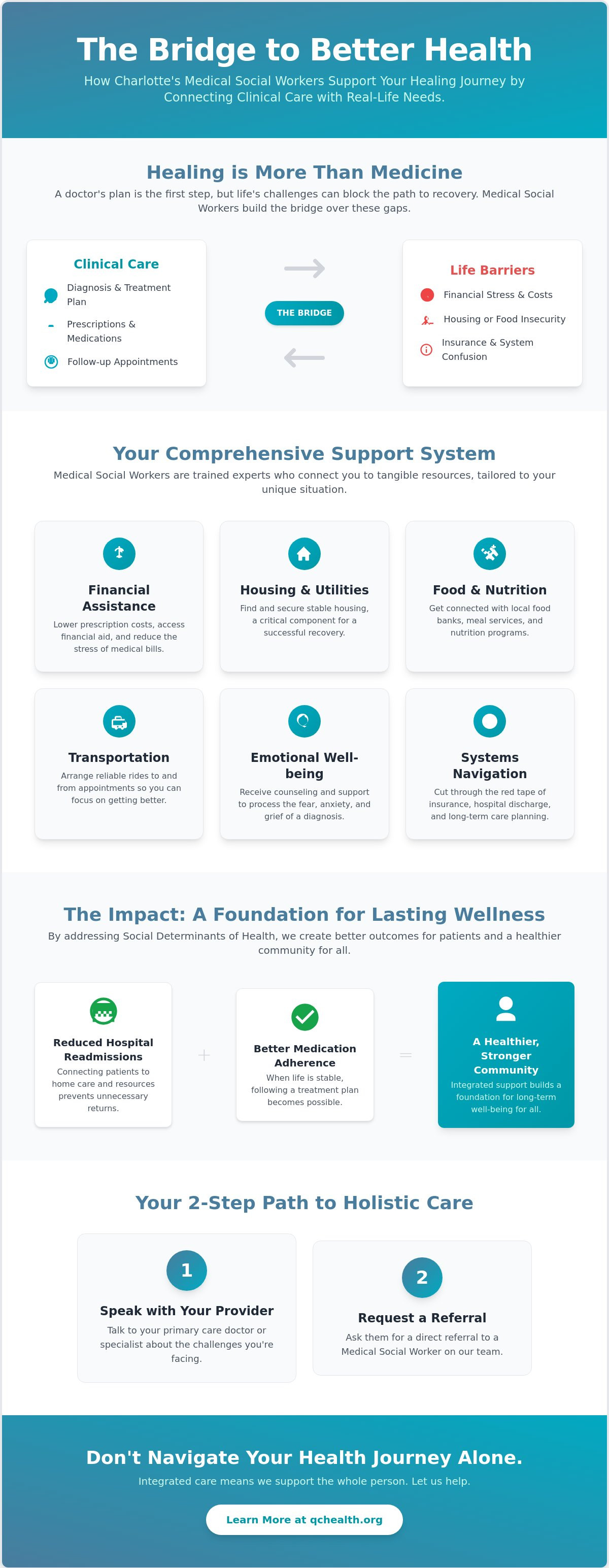
Overcoming Barriers: Why Integrated Support Matters
Medicine is a powerful tool, but it doesn't work in a vacuum. For many, the greatest obstacles to recovery aren't clinical; they're social and structural. Charlotte medical social worker services are designed to dismantle these hurdles so your treatment can actually take root. We often see patients who feel a sense of shame about needing help with food or bills. It's time to reframe that thinking. Seeking social support is a profound act of Health Literacy. It shows you understand that your environment dictates your wellness as much as your biology does.
Hidden barriers often stand between a patient and their goals. Language differences, digital literacy gaps, and a long history of cultural mistrust in healthcare can make even a simple clinic visit feel like a battle. How Medical Social Workers Help is by serving as a trusted guide through these complexities. They advocate for you when the system feels deaf to your needs. They also simplify the how to get medical care with a high deductible plan process, ensuring that financial paperwork doesn't prevent you from seeing a specialist or filling a prescription.
The impact of this integrated support on mental health cannot be overstated. When you aren't worrying about where your next meal is coming from or how you'll pay for your HIV treatment, your mind can focus on healing. This peace of mind is a clinical necessity. It reduces the chronic stress that often worsens physical symptoms, creating a positive cycle of wellness that benefits the entire community.
Breaking the Cycle of Health Disparities
Our work is deeply rooted in the specific needs of our neighbors. We focus heavily on the Beatties Ford Road corridor, where historical disinvestment has created unique challenges for families seeking care. By providing culturally affirming care, we ensure that every patient feels seen, heard, and respected. Social workers reduce the 'anxiety of the unknown' by translating complex hospital jargon into actionable steps for your daily life. This clarity leads to better compliance and, ultimately, better health outcomes for our most underserved populations.
Support for Caregivers and Families
Chronic illness doesn't just affect the individual; it impacts the entire household. Caregivers often face burnout and isolation while trying to manage a loved one’s complex needs. Identifying resources. Coordinating respite. Building community. We offer several ways to support the family unit:
Respite Resources: Finding temporary care options so primary caregivers can rest and recharge.
Educational Workshops: Teaching families how to safely manage medical equipment or recurring care at home.
Local Support Groups: Connecting you with other Charlotte families who understand the unique weight of your journey.
When the family is supported, the patient is supported. We believe that by lifting up the caregiver, we strengthen the entire foundation of care for the long term.
How to Access Social Worker Services in Charlotte
Accessing Charlotte medical social worker services shouldn't feel like another hurdle in an already difficult journey. It's a structured path toward total wellness that starts with a simple conversation. We believe that healthcare is a shared responsibility. When you're ready to bridge the gap between your clinic visits and your daily life, the process is designed to be clear, supportive, and deeply personal. Identifying needs. Building plans. Securing futures. Our goal is to move you from a place of uncertainty to a position of strength.
The first step is often the easiest. During your next appointment for primary care or specialty services, simply ask your provider for a referral. Whether you're managing a chronic illness or navigating a new diagnosis, your doctor can connect you directly with a social worker. Once the referral is made, you'll schedule an initial intake. This isn't a clinical exam. It's a heart-to-heart discussion about your "kitchen table" issues, such as food insecurity, housing instability, or the stress of medical bills. From there, you'll collaborate on a social care plan tailored specifically to your living situation. We don't just set it and forget it; we schedule regular check-ins to adjust your resources as your health and life circumstances change.
Where to Find Help in Mecklenburg County
Community health centers, often known as Federally Qualified Health Centers (FQHCs), serve as the primary hub for these vital social services in our city. While hospital-based social workers focus heavily on the mechanics of a safe discharge, community-based social workers focus on your long-term stability at home. If you're in the Beatties Ford Road area or other underserved parts of Mecklenburg County, these centers are your best resource for consistent advocacy. You can also utilize the 211 system for immediate needs, but a dedicated medical social worker provides the personal accountability and follow-through that a phone line cannot offer.
What to Bring to Your First Meeting
Preparation empowers you to get the most out of your first session. To ensure we can move quickly, please consider bringing the following items:
Income Documentation: This helps us determine your eligibility for sliding fee scales or local financial assistance programs.
Medication List: Bring your current prescriptions and your preferred pharmacy so we can look for cost-saving opportunities.
Stability Goals: Think about what "being stable" looks like for your family. Is it a reliable ride to the clinic? Is it a full pantry?
By arriving with these details, you help us hit the ground running. Our practitioners are committed to personal accountability, ensuring that every document you bring is used to build a stronger foundation for your health. If you're feeling overwhelmed by the logistics of your care, reach out to our team to start your social care plan today.
Holistic Care at Quality Comprehensive Health Center
For over 20 years, Quality Comprehensive Health Center has served as a foundational civic pillar for our neighbors in Mecklenburg County. We believe that true wellness requires more than just a clinical prescription. It requires a deep-seated commitment to advancing Health Equity through every interaction. By integrating Charlotte medical social worker services directly into our Primary and Specialty care teams, we ensure that no patient has to navigate the complexities of life alone. Our approach is rooted in Social Advocacy, providing a warm and inclusive environment where every individual is treated with the worthiness they deserve.
The QCHC difference lies in our unique blend of approachable excellence and modern facilities. While our technology is advanced, our care remains deeply human and personally attentive. We understand that marginalized populations often face barriers that go beyond the exam room. Our social workers act as principled advocates, working alongside our clinicians to dismantle these obstacles. This judgment-free support ensures that whether you are here for pediatric care or behavioral health services, your social and emotional well-being is prioritized with the same rigor as your physical health. We don't just see a diagnosis; we see a neighbor who deserves a path to stability.
Our Integrated Care Model
Stability begins with coordination. In our model, your doctor, therapist, and social worker are not just separate providers; they are a unified team working for you. Seamless coordination. Personalized attention. Human-centered advocacy. This collaborative effort means that if you need help with medication costs, our on-site pharmacy support is immediately involved in your care plan. We treat you as a whole person, not just a patient number on a chart. By centering our principles on your unique needs, we transform the standard clinical experience into a journey of belonging and trust.
Join Our Community of Care
Choosing a healthcare provider is an act of trust. At Quality Comprehensive Health Center, we honor that trust by providing a human face to every service we offer. Our practitioners are personally accountable for your success, ensuring that our high standards of service are met at every turn. We remain humble and focused on our mission to serve the underserved with both excellence and empathy. If you are ready to experience healthcare that sees the whole you, we invite you to schedule a consultation with our advocacy team today. Healing the individual. Supporting the family. Strengthening the collective.
Empowering Your Journey to Total Wellness
Healing requires more than a clinical diagnosis; it requires a foundation of stability. We've explored how dedicated advocates remove the "life barriers" that often prevent medicine from working. From securing transportation to recurring appointments to lowering prescription costs, these professionals ensure your path to recovery is clear. You aren't just a patient number. You're a valued member of our community who deserves comprehensive support.
Quality Comprehensive Health Center has spent over 20 years advancing health equity in Mecklenburg County. Our state-of-the-art facility on Beatties Ford Road provides a modern environment for integrated Primary, Behavioral, and Social Care. By choosing Charlotte medical social worker services through our center, you're choosing a team that values your human dignity above all else. We prioritize your worthiness and provide the tools you need to thrive in every aspect of your life.
It's time to experience a healthcare system that listens and acts. Don't let financial stress or social isolation stand in the way of your wellness. Connect with a QCHC Advocate Today to begin building your personalized social care plan. We are here to walk this journey with you. Every step of the way. Your health is a shared responsibility, and we are honored to stand by your side.
Frequently Asked Questions
Is there a cost to speak with a medical social worker in Charlotte?
Most community health centers include these services as part of your overall care visit to ensure medicine is accessible to everyone. We believe that financial concerns should never prevent a neighbor from receiving the advocacy they deserve. Our team focuses on lowering barriers to wellness by integrating social support directly into our clinical model, ensuring every person receives high-quality care regardless of their current budget.
Can a medical social worker help me if I don't have health insurance?
You can absolutely receive assistance even if you do not have health insurance. Charlotte medical social worker services are specifically designed to help uninsured and underinsured individuals navigate the complexities of the healthcare system. We assist you in finding sliding fee scales, local grants, and pharmaceutical assistance programs that make your medical treatment affordable, sustainable, and effective for your long-term health.
How is a medical social worker different from a therapist?
A medical social worker focuses on the practical and social barriers to your recovery, while a therapist primarily provides clinical mental health treatment. While both professionals offer deep emotional support, the social worker's role is centered on Resource Navigation. They connect you to food, housing, and financial aid to ensure your physical environment supports your healing process and restores your personal dignity.
Can a social worker help me get transportation to my doctor's appointments?
Yes, social workers specialize in coordinating reliable transportation for recurring medical needs such as dialysis, oncology, or specialty treatments. They tap into local Charlotte programs and insurance-provided transport benefits to ensure you never miss a vital appointment. Removing these travel hurdles is a key part of our mission to provide personally attentive care to every member of our community.
Do I need a doctor's referral to see a social worker at QCHC?
We typically recommend starting with a referral from your primary care provider or specialist to ensure your social care is fully integrated with your clinical treatment. This collaborative approach allows our practitioners to understand your specific medical needs before the intake process begins. However, you can always mention your social or financial concerns during any visit to start the connection with an advocate.
Can medical social workers help with housing or utility bills?
Medical social workers act as principled advocates to link families with local housing programs and utility assistance grants throughout Mecklenburg County. They don't provide the funds directly; instead, they help you navigate the application processes for various community resources. Ensuring you have a warm home and a stable place to sleep is a clinical necessity that directly impacts your recovery and wellness.
What should I expect during my first meeting with a social worker?
Your first meeting is a welcoming, judgment-free conversation about the non-medical challenges currently impacting your life. You'll discuss your living situation, financial stressors, and family goals to help the social worker build a personalized "Care Map." This session is an essential first step in moving from a place of seeking trust to receiving the actual professional treatment and resources you need.
Are medical social worker services confidential?
Every conversation you have with our Charlotte medical social worker services team is strictly confidential and protected by federal HIPAA laws. Your privacy is a foundational principle of our organization. We only share information with your specific clinical team to coordinate your care, ensuring your personal journey remains respected, secure, and centered on your individual worthiness within our community of care.


Comments