


Community Pharmacy in Charlotte, NC for Refills and Transfers

The most useful community pharmacy in Charlotte, NC is one that fits your routine and can handle the prescription task you need. Start with a location that suits your regular routes, then check its refill process or ask about transferring a prescription. A simple plan makes the next step easier.
Keeping prescriptions current takes coordination, especially when changing pharmacies or managing care for family members. This guide explains how to find pharmacy locations in Charlotte and what information to have ready for a refill or transfer. It also covers what to expect from each process and how community-based care can support your health needs.
Table of Contents
Pharmacy locations in Charlotte
A community pharmacy in Charlotte, NC is easier to reach when it fits your regular routes. Start with the area where you spend most weekdays, such as Uptown, South End, University City, or Ballantyne. Compare addresses with home, work, school, or transit stops. A convenient location can make prescription pickup and routine questions easier to manage.
Use a map or pharmacy directory to find nearby locations, then narrow the results by practical needs. Check the street address, posted hours, and directions before planning a visit. Someone who works in Uptown, for example, may prefer a pharmacy near the office, while a caregiver may prioritize a location near a family member’s home. Keep the exact address handy when calling or arranging a transfer.
Before choosing, consider how you’ll get there and what support you need. A nearby location may suit regular pickup, while another may fit a route you already travel. Check parking, public transit access, and whether the entrance is manageable for you or someone you assist. These details help you choose a realistic option for everyday care.
How can you verify a pharmacy is licensed in North Carolina? Use the North Carolina Board of Pharmacy’s license lookup and search by the pharmacy’s name or address. Compare the record with the location you plan to visit to make sure you’re checking the right business.
Services beyond prescription filling may include medication counseling, immunizations, and health screenings. When comparing Charlotte locations, ask which services the pharmacy provides and how to access them. Someone who needs help understanding prescription instructions may value counseling, while a person seeking an immunization can ask specifically about that service. The answers can help you choose a pharmacy that suits more than pickup needs.
Before your first visit, prepare a short list of details to make the location useful for you:
Address: Save the street address and directions for the correct branch.
Hours: Review posted opening and closing times before traveling.
Prescription needs: Note the medication name and the current pharmacy’s details.
Accessibility: Consider parking, transit, and the route from the entrance.
Additional services: Identify whether counseling, immunizations, or screenings matter to you.
These steps help you compare locations without relying on distance alone. A pharmacy near home may be convenient, but one close to work or a regular appointment could better fit your routine. Keep the pharmacy’s name and address with your prescription information to identify the right location when arranging a refill or transfer.
Prescription refills and transfers
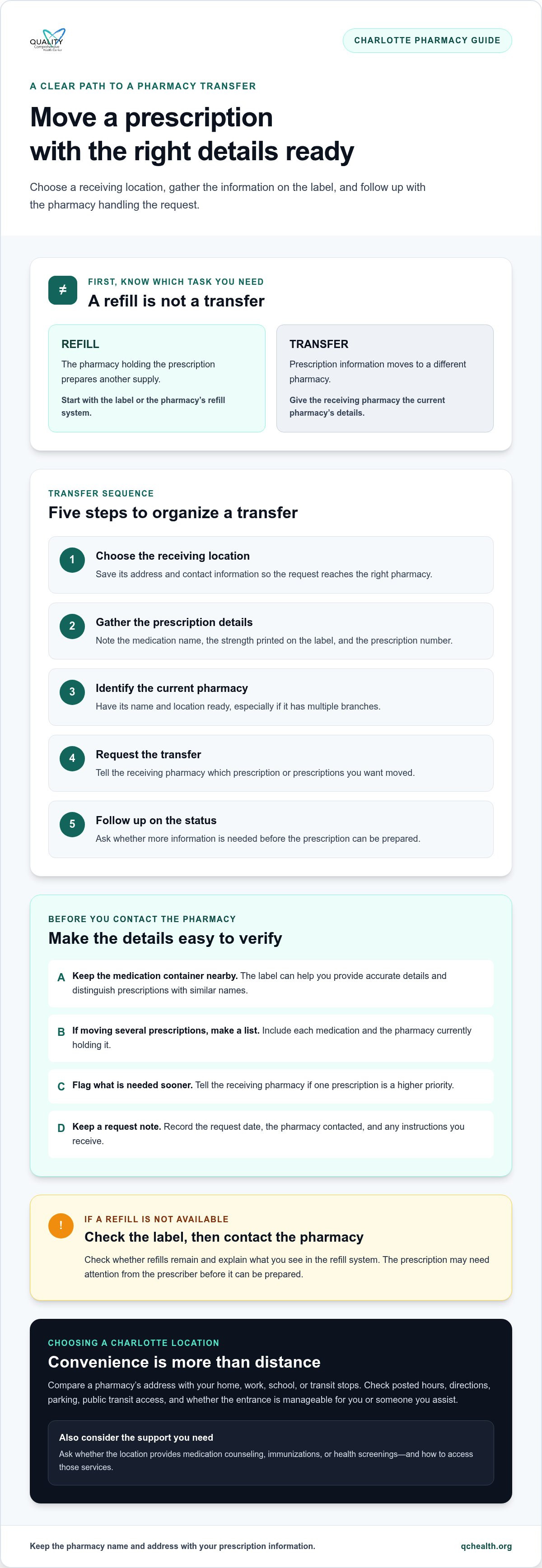
For a refill, start with the prescription label or the pharmacy’s refill system. Record the medication name and prescription number, then follow the instructions. If you use an online account, select a prescription marked as eligible for refill. If it isn’t available, contact the pharmacy to learn what information is needed.
A refill and a transfer are different tasks. A refill asks the pharmacy holding the prescription to prepare another supply. A transfer moves prescription information to another pharmacy. If you’re changing locations, give the new pharmacy the current pharmacy’s name, address, and phone number, along with the medication details. This helps staff find the correct record.
Use this simple sequence to organize a transfer:
Choose the receiving location. Save its address and contact information so the transfer request reaches the right pharmacy.
Gather prescription details. Note the medication name, strength as printed on the label, and prescription number.
Identify the current pharmacy. Give its name and location, especially if it has multiple branches.
Request the transfer. Tell the receiving pharmacy which prescriptions you want moved.
Follow up on the status. Ask whether more information is needed before the prescription can be prepared.
If you’re moving from one Charlotte neighborhood to another, you can request a transfer before your next pickup is due. Keep the medication container nearby as you make the request. Its label can help you give accurate details and avoid confusion between prescriptions with similar names.
If you can’t request a refill through the usual process, check the label for remaining refills and contact the pharmacy. The prescription may need attention from the prescriber before it can be prepared. Share the medication name and explain what you see in the refill system. That gives the pharmacy a clear starting point.
When transferring several prescriptions, make a list instead of naming them from memory. Include each medication and the pharmacy that currently holds it. Tell the receiving location if one prescription is needed sooner than the others. This helps staff understand your priorities and identify which records need follow-up.
Keep a note of the request date, the pharmacy contacted, and any instructions you receive. If a prescription doesn’t appear in the new pharmacy’s account, that note can help you explain which transfer needs attention. For ongoing medication questions alongside other care needs, explore community health support through Quality Comprehensive Health Center.
After discharge from an acute care facility, compare the medication list you’re using with the prescriptions you want to refill or transfer. Quality Comprehensive Health Center transitional care medication management identifies discrepancies and updates medication lists after discharge from an acute care facility.
Keep the medication container and current list available when discussing a discrepancy, and describe which prescription or list entry does not match. Ask the pharmacy what information it needs, and contact the prescriber when directed, so the refill or transfer request can be handled using the updated information.
Which community pharmacies in Charlotte offer delivery or curbside pickup?
Delivery and curbside pickup are pharmacy-specific services, so compare Charlotte locations individually. Start with the pharmacy’s official location information and look for details tied to that branch. If a service description lists several locations, match it to the exact street address you plan to use. A chain’s general service page may not describe every branch.
Use a short checklist when comparing locations:
Service: Ask whether the branch offers delivery, curbside pickup, or both.
Address: Give the delivery destination or identify the branch for pickup.
Request method: Ask whether to arrange the service by phone, online account, or another process.
Timing: Ask how the pharmacy communicates the pickup or delivery schedule.
Prescription details: Have the medication name and refill information available.
These questions clarify what to do after placing a refill request. For curbside pickup, ask where to park and how staff will know you’ve arrived. For delivery, provide the correct address and ask how the pharmacy will coordinate the handoff. Share any requested details, such as your apartment building name and delivery instructions.
Ask whether the same process applies to every prescription. A refill, a new prescription, and a transfer can involve different steps. If you’re arranging delivery for a refill, say so clearly. If the prescription is being transferred, first identify the receiving pharmacy, then ask how delivery can be arranged once it’s ready.
Keep the location’s name, phone number, and instructions together in your notes. If a family member is collecting a prescription, tell the pharmacy who will arrive and ask what information they should provide. A caregiver can confirm the branch and pickup arrangement before leaving home, helping avoid a trip to the wrong location or confusion about the service.
When comparing a community pharmacy in Charlotte, NC, prioritize the option that fits your transportation and routine. Note the branch’s answer about delivery or curbside pickup and use it when planning future refills. Confirm the service with the same location when your next prescription is due, especially if you’re using a different branch.
Which Charlotte community pharmacies accept my insurance or Medicare Part D?
Coverage depends on your specific health plan, not just the pharmacy’s name. A Charlotte pharmacy may participate in one plan’s network but not another’s. Medicare Part D plans also have their own pharmacy networks. Check the exact plan name on your insurance card before choosing a location. If you have more than one card, identify which plan covers prescriptions.
Start with your plan’s pharmacy directory or member services. Search the pharmacy’s full name and Charlotte address, then compare the result with the branch you intend to visit. A chain can have several local locations, so checking the name alone may not identify the right one. Confirm the address near your home, not another branch across Charlotte.
Then contact the pharmacy with your plan details. Give the insurer or Medicare Part D plan name and ask whether that specific branch participates. Have the member ID and group details from your card ready if requested. Ask whether the answer applies to the prescription you need, since coverage can depend on both the plan and medication.
Use this checklist to make the comparison clear:
Plan name: Read the full name printed on your insurance or Medicare Part D card.
Pharmacy branch: Match the pharmacy’s street address to your intended location.
Medication: Provide the medication name when asking about coverage.
Plan directory: Search the insurer’s pharmacy listing for that branch.
Confirmation details: Note whom you spoke with and any instructions provided.
If you’re comparing two Charlotte locations, use the same plan and medication details for both. This keeps the comparison focused. Ask whether each branch participates in your particular plan, rather than whether it takes insurance generally. If you use Medicare Part D, say so and give the plan name shown on your card.
Keep the answer with your prescription information. If your plan changes, repeat the check using your new card details. Your previous pharmacy choice doesn’t confirm whether a different plan includes that branch. A directory entry is most useful when its address matches the location where you’ll request service.
Before arranging a refill or transfer, confirm the location and plan together. Ask what information the pharmacy needs to process the prescription under your coverage. If you’re calling for someone else, have their plan card and prescription details ready. These steps help you identify the right Charlotte pharmacy for your insurance or Medicare Part D plan.
Coverage checks are separate from medication-management support. Community Care of North Carolina care managers may collect patients’ medication lists and containers for medication reconciliation, which a pharmacist then reviews. Its pharmacists conduct comprehensive medication reviews for more complex patients and communicate medication issues to a patient’s primary care provider after reviewing reconciliations or conducting comprehensive reviews. Chronic care patients may be referred for medication management by a care manager, primary care provider, or pharmacist involved in the primary care practice.
For ongoing prescriptions, Community Health Care recommends that patients order 90 to 180 days’ worth of medication by mail, if possible. Check your plan’s mail-order rules and pharmacy network before ordering.
Charlotte Community Pharmacy Vaccinations & Walk-ins
Vaccination services and walk-in access are separate details to confirm for each Charlotte pharmacy. A location may list immunizations online but require scheduling. Another may accept walk-ins for certain services or at certain times. Search for the exact branch, then contact it before traveling to ask whether it offers the vaccine you need and how to arrange a visit.
Be specific when asking. Name the vaccine, say whether you want an appointment or walk-in visit, and identify the branch. “Do you offer this vaccine at your South End location, and can I come without an appointment?” gives staff a clear question to answer. If you’re asking for a child or another family member, mention that too.
Before you go, prepare the information the pharmacy requests. Have any vaccination record available, along with identification and insurance details if applicable. If you don’t have a record, explain that when you contact the pharmacy. Someone who remembers receiving a vaccine but lacks paperwork can ask what information would help staff review their history.
Location: Confirm the Charlotte branch’s full address.
Vaccine: Name the specific immunization you’re seeking.
Visit type: Ask whether appointments, walk-ins, or both are offered.
Preparation: Ask what records or information to bring.
Access: Clarify where to enter and whom to check in with.
Walk-in availability can depend on the branch’s process and the vaccine requested. Ask whether walk-ins are accepted that day instead of assuming every location follows the same approach. If you’re planning around work, school pickup, or transportation, ask about the visit process before setting out. A quick call can help you avoid arriving at a branch that requires appointments.
Note the branch, vaccine, and instructions you receive. If you visit another location later, ask the same questions for that branch. A pharmacy’s Uptown and University City locations, for instance, may have different scheduling processes. Treat each address as a separate destination when planning an immunization visit.
If you need help coordinating broader health needs alongside a vaccination search, explore community health services. For the pharmacy visit itself, use the location’s instructions and bring the records it asks you to provide. That keeps the next step clear for you and the staff assisting with your visit.
Quality Comprehensive Health Center: Specialty care
Quality Comprehensive Health Center can support you when prescription needs connect with broader health concerns. If you need ongoing care beyond a pharmacy visit, its specialty care and primary care services offer a clinical next step. Families can also access pediatric care, and behavioral health services support mental and emotional well-being.
You may be managing a health condition alongside medication questions, or seeking care for a child while also supporting your own well-being. A conversation about your needs can help you identify which service fits your situation.
Contact Quality Comprehensive Health Center or visit qchealth.org to take the next step.
Make Your Next Care Step Count
Choosing a community pharmacy in Charlotte, NC can be one part of a broader health plan. As your needs change, consider how medication support fits alongside care for ongoing conditions, family health, or emotional well-being. A useful next step is to identify the kind of support that would help you feel more connected to your care.
Quality Comprehensive Health Center offers specialty care, primary care, and pediatric care. These services can support individuals and families seeking care beyond prescription needs. When you’re ready to explore how these options may fit your situation, contact Quality Comprehensive Health Center.
Steady care starts with a step that works for you. Choose the support that helps you move forward with confidence.
Frequently Asked Questions
What independent community pharmacies are in Charlotte, NC?
Quality Comprehensive Health Center is a community-based healthcare provider in Charlotte with Pharmacy among its offerings. The center’s information doesn’t establish whether it is independently owned. For a specific pharmacy, review the business’s own ownership information or ask the pharmacy directly. Before choosing, compare its location, prescription support, and insurance participation with your needs. A community health center that offers pharmacy services is not necessarily an independently owned pharmacy.
What are the operating hours and locations of Charlotte community pharmacies?
Hours and addresses differ by pharmacy, so use the exact branch’s current location information when planning a visit. Quality Comprehensive Health Center’s clinic is at 3607 Beatties Ford Road, Charlotte, NC 28216, and its clinic hours are Monday through Friday, 9:00 a.m. to 5:00 p.m. Those are clinic hours. For a pharmacy visit, confirm the relevant pharmacy location and its schedule before traveling.
How do I transfer a prescription to a community pharmacy in Charlotte?
Choose the receiving pharmacy, then give it the prescription details and the name and location of the pharmacy currently holding the prescription. If you’re transferring several medications, list each one separately and flag anything you need soon. Keep the containers or labels nearby to avoid mixing up names or strengths. A caregiver can prepare the list before calling, then note any follow-up instructions.



Comments