


5 Signs You Might Need to Talk to a Therapist: A Guide for Charlotte Families

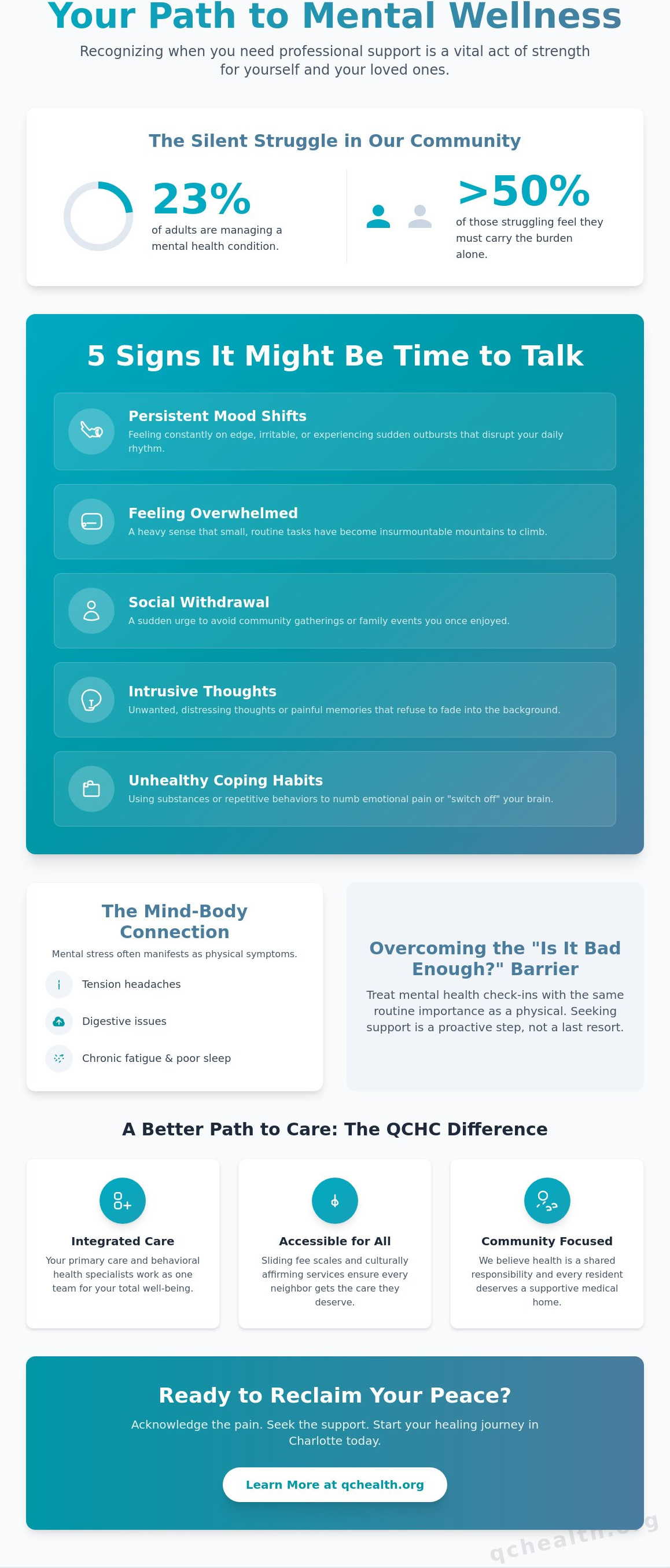
In 2026, nearly 23% of adults are managing the weight of a mental health condition, yet over half of our neighbors feel they must carry that burden alone due to high costs or a confusing system. You may find yourself wondering if your exhaustion is just a phase or if your family's recent tension is something more. It is easy to feel misunderstood by friends or overwhelmed by a healthcare landscape that feels built for institutions rather than people. Recognizing the signs you might need to talk to a therapist is not a mark of failure. It is a vital act of strength for yourself and your loved ones.
We believe that health is a shared responsibility and that every Charlotte resident deserves a supportive medical home. This guide will help you identify the subtle signals of mental fatigue while providing a clear path to accessible, community-centered Care. You will learn the five specific indicators that professional support is necessary and how to connect with our Behavioral health services. Seeing the struggle, validating the pain, and providing the path; let us help you move from surviving to thriving.
Key Takeaways
Discover why mental wellness is a foundational Pillar of your overall health and how seeking support is a proactive step toward personal empowerment.
Identify the five subtle signs you might need to talk to a therapist, including persistent mood shifts and the feeling that small tasks have become insurmountable.
Overcome the "is it bad enough" barrier by learning to treat mental health check-ins with the same routine importance as a visit to your primary care provider.
Learn how to access culturally affirming Behavioral health services in Charlotte that utilize sliding fee scales to ensure every neighbor receives the Care they deserve.
Table of Contents
Understanding Mental Wellness and Behavioral Health
Your mental health is a foundational pillar of your overall physical well-being. It is the quiet engine that powers your ability to work, love, and thrive in a busy world. When we look at Understanding Mental Wellness, we realize it is about much more than just avoiding a crisis. It is about the quality of your daily life and your resilience in the face of change. In our Charlotte community, we view health as a collective effort. We aren't just isolated individuals; we are a network of families and neighbors who rely on one another. Choosing to seek help is a proactive choice for personal empowerment. By learning the signs you might need to talk to a therapist, you are standing up for your right to a full and vibrant life.
The Link Between Mind and Body
The body keeps a record of everything we feel. Mental stress rarely stays inside the mind. It often leaks out into the physical world as tension headaches, digestive issues, or a fatigue that feels heavy in your bones. If you treat the body without listening to the mind, you are only solving half of the puzzle. We believe in treating the whole person rather than just managing isolated symptoms. This philosophy is the heartbeat of our integrated behavioral health primary care Charlotte model. When your primary care provider and behavioral health specialist work as one team, you receive care that is both technologically advanced and deeply human. Your physical health and mental clarity are two sides of the same coin.
Reframing the Stigma of Therapy
Common misconceptions often label therapy as "talking to a stranger" about things that should stay at home. This perspective creates unnecessary barriers that keep our families from flourishing. We see therapy differently. It is a professional tool designed to advance health equity and provide every resident with the resources they need to succeed. Support should never be a last resort or a source of shame. It is a bridge to a better version of yourself.
Acknowledge the pain. Seek the support. Reclaim your peace.
Using professional services is a sign of immense courage and self-awareness. When you recognize the signs you might need to talk to a therapist, you are acting as a leader for your family. You are showing your children that their emotions matter and that professional help is a valid, healthy resource. Our mission is to ensure that every person in Charlotte feels worthy of this Care. We are here to lower the barriers and provide a welcoming environment where you can finally be heard.
5 Signs You Might Need to Talk to a Therapist
Life in Charlotte moves at a rapid pace. Between managing career goals and family commitments, it is easy to dismiss your internal struggles as simple stress. However, recognizing the signs you might need to talk to a therapist is a vital step toward reclaiming your peace. It is not about waiting for a total breakdown. It is about identifying the subtle shifts in your emotional landscape before they become overwhelming. When you understand these 5 Signs You Might Need to Talk to a Therapist, you gain the power to act. Watch for these indicators in your daily life:
Persistent changes in your mood that disrupt your typical daily rhythm.
A heavy sense of being overwhelmed where small, routine tasks feel like insurmountable mountains.
Social withdrawal and a sudden urge to avoid community gatherings or family events.
Intrusive thoughts or painful memories that refuse to fade into the background.
The use of substances or repetitive habits to numb emotional pain or "switch off" your brain.
Identify the shift. Seek the truth. Reclaim your joy. If these patterns feel familiar, our Behavioral health services offer a supportive space to begin your healing journey.
Emotional Volatility and Uncontrollable Feelings
You might find yourself feeling constantly on edge. Irritability becomes your default setting. Sudden outbursts of anger or tears happen over minor inconveniences. These are not personality flaws or signs of weakness. Instead, they are signals of intense internal pressure that needs a safe, professional release. When your emotional "check engine light" is flashing, it is a clear call for a professional evaluation to help you process what lies beneath the surface.
Changes in Physical Habits: Sleep and Appetite
The body often speaks when the mind cannot. You may notice a "too much or too little" pattern emerging in your basic needs. Perhaps you are eating to cope with stress, or maybe you have lost your appetite entirely. Sleep often suffers first, leaving you with no energy for your children or your work. In 2026, clinical health guidelines recommend maintaining a consistent sleep-wake window of 30 minutes every day to regulate cortisol and support emotional resilience. When these physical foundations crumble, your mental health is often the underlying cause.
Loss of Interest in Community and Joy
Anhedonia is the clinical term for when activities you once loved no longer bring you pleasure. You might stop visiting Freedom Park or skip the local neighborhood cookouts you used to enjoy. This withdrawal from Charlotte social circles can lead to deep isolation. Re-engaging with your life and your community starts with a single, honest conversation. You deserve to feel connected and vibrant again.
Overcoming the "Is it Bad Enough?" Barrier
Many neighbors believe they must hit rock bottom before reaching out for professional support. This "crisis-only" mindset is a significant barrier to long-term wellness. If you wait until the walls are closing in, you miss the opportunity to build a foundation of resilience. We encourage you to view mental health check-ins with the same regularity as your routine primary care visits. Early intervention is not just a clinical recommendation. It is a vital strategy for preventing long-term health disparities in our community.
Recognizing needs, seeking support, achieving balance.
This three-part process is how we move forward together. You don't need a catastrophic event to justify your feelings. If you are noticing the signs you might need to talk to a therapist, that observation alone is enough to warrant a conversation. By identifying these signals before life feels unmanageable, you are choosing a path of strength. Your emotional state is a valid priority regardless of how "bad" things seem compared to others.
Preventative Care for Your Mind
Talking to a professional early in your journey helps build the emotional tools needed to weather life's storms. Think of therapy as "mental maintenance" rather than "emergency repair." Just as you wouldn't ignore a strange sound in your car's engine until it breaks down on I-77, you shouldn't ignore persistent emotional fatigue. When you are ready to start, these Tips for Talking With a Health Care Provider can help you start that first appointment with confidence. Proactive Care ensures that you remain the leader of your own life story. For more information on local resources, explore our Finding the Right Charlotte Care Center guide.
Validation of Your Worthiness
One of the most common reasons people hesitate is the fear of "burdening others" with their problems. You might feel that your friends and family have enough on their plates. However, your peace of mind is an investment that pays dividends for everyone around you. A healthy you is a more present parent, a more engaged worker, and a more vibrant neighbor. We stand as a principled advocate for your well-being. We function as a supportive neighbor ready to listen without judgment. You are worthy of the time it takes to heal. You are worthy of the resources it takes to thrive. When you recognize the signs you might need to talk to a therapist, you are acknowledging your own value.
How to Start Your Healing Journey in Charlotte
Taking the first step toward professional support is a profound act of leadership for your family. Once you recognize the signs you might need to talk to a therapist, the focus shifts to finding a space where your culture, experiences, and history are honored. Charlotte is a vibrant city, but it can also be a place of unique stressors. You need a partner who understands the local landscape, from the fast-paced growth of our neighborhoods to the specific challenges faced by our underserved communities. Finding a therapist isn't just about booking an appointment; it is about building a relationship based on trust and mutual respect.
Identifying your needs, choosing your partner, reclaiming your future.
This journey requires a provider who sees you as a whole person, not just a set of symptoms. In our community, licensed clinical social workers and professional counselors serve as vital guides. These professionals are trained to help you process the signs you might need to talk to a therapist while offering practical strategies for daily life. They act as principled advocates for your well-being, ensuring that your voice remains the most important one in the room. When you are ready to begin, our Behavioral health services are here to welcome you home.
Finding an Affirming Provider
A state-of-the-art facility should never feel cold or detached. We believe that modern medicine is at its best when it is paired with a deep, human touch. Our Beatties Ford Road location serves as a hub for this mission, providing a welcoming environment where every neighbor feels a sense of belonging. When searching for a provider, look for a team that prioritizes cultural humility. You deserve to feel seen and heard by a clinician who understands your background. This personal connection is the foundation of effective Care, allowing you to speak your truth without fear of judgment or misunderstanding.
Navigating Costs and Insurance
Quality Care should never be a financial burden for Charlotte families. We recognize that the high cost of private therapy often keeps people from seeking the help they deserve. Community-based centers are designed to lower these barriers, ensuring that health remains a shared right rather than a luxury. If you are currently uninsured, do not let that stop your progress. Many community health homes offer sliding fee scales based on your income, making professional support accessible for everyone. We are committed to health equity, ensuring that every resident has a path to wellness regardless of their financial standing. Your peace of mind is an investment we are honored to support.
Integrated Care: The QCHC Difference
At Quality Comprehensive Health Center, we believe that true healing happens when the mind and body are treated as one. Most healthcare systems force you to navigate separate buildings, disconnected records, and different providers. We choose a different path. By housing our Behavioral health services and Primary care under one roof, we ensure that your medical team is always in conversation. This integrated approach is a cornerstone of our mission to advance health equity for every family in Charlotte. When you recognize the signs you might need to talk to a therapist, you shouldn't have to start your journey from scratch in a detached institution.
Seeing the person. Treating the whole. Advancing the community.
Our team-based model means that your physical health and mental wellness are monitored together. If a primary care visit reveals physical symptoms of stress, our behavioral health specialists are already part of your support network. This seamless transition reduces the "referral fatigue" that often prevents people from following through with treatment. We are not just a clinic; we are a medical home where your story is known and your worth is celebrated. By removing the logistical hurdles of seeking support, we make it easier for our neighbors to prioritize their peace of mind.
Our Compassionate Behavioral Health Team
Our services are led by licensed experts who are deeply invested in the well-being of the Charlotte community. These practitioners bring a blend of clinical authority and neighborly empathy to every session. We operate out of a state-of-the-art facility designed specifically to prioritize your comfort and privacy. For over 20 years, we have maintained a legacy of serving the underserved with Excellence. We understand that marginalized populations often face higher barriers to quality treatment, and we have built our organization to tear those barriers down. You are not just another appointment; you are a vital member of our collective effort toward a healthier city.
Your First Step Toward Excellence
If you've been noticing the signs you might need to talk to a therapist, we invite you to schedule a Mental Health Check-in. This is an opportunity to experience our "approachable excellence" firsthand. You don't need to be in a state of emergency to deserve professional attention. Our doors are open to those seeking clarity, resilience, and a sense of belonging. We provide a clear path to wellness that respects your time and your dignity. Let us help you navigate the complexities of the healthcare system so you can focus on what matters most: your healing.
Helping individuals. Advancing equity. Providing Care.
Supporting you, strengthening families, building community.
Reclaiming Your Peace of Mind
Recognizing the signs you might need to talk to a therapist is a vital act of self-awareness that benefits your entire family. We've seen that mental wellness is a foundational pillar of your physical health; it's the engine that allows you to work, love, and thrive. By choosing early intervention, you're building the resilience needed to face life's challenges with confidence. You don't have to carry the weight of mental fatigue alone. It's time to prioritize your well-being as a shared community responsibility.
With over 20 years of community-based healthcare experience, our team is dedicated to providing approachable excellence for every neighbor. We provide integrated medical and behavioral health services under one roof to make your healing journey as seamless as possible. For those currently uninsured, we offer a sliding fee scale to ensure that quality Care remains accessible to all. Your health is our mission. Your worth is our promise.
Acknowledge the need. Seek the support. Achieve the balance.
Schedule your Mental Health Check-in at our Charlotte Center today.
You're worthy of a vibrant and fulfilling life. We're ready to walk beside you as you take this courageous first step toward lasting wellness.
Frequently Asked Questions
How do I know if my stress is "normal" or if I need therapy?
Stress is a natural part of life, but it requires professional attention when it starts to disrupt your ability to work, sleep, or maintain relationships. If your usual coping mechanisms no longer provide relief, these are clear signs you might need to talk to a therapist. We view therapy as a proactive tool for personal empowerment. It helps you build the resilience needed to manage life's pressures before they lead to a total burnout.
Can I see a therapist in Charlotte if I do not have health insurance?
You can absolutely access Care at QCHC even if you do not have health insurance. We are a foundational civic pillar dedicated to health equity, which is why we offer a sliding fee scale based on your household income. This program ensures that financial barriers never stand in the way of your mental wellness. Every neighbor deserves a supportive medical home, regardless of their current financial standing or insurance status.
What is the difference between a counselor and a psychiatrist?
A counselor or licensed clinical social worker typically focuses on talk therapy and developing healthy coping strategies for daily life. A psychiatrist is a medical doctor who can diagnose complex conditions and prescribe medication when necessary. At QCHC, our team-based approach means these professionals work together. We integrate these services to ensure your treatment plan is holistic and addresses every aspect of your well-being.
How long does a typical therapy session last at QCHC?
A typical behavioral health session at our center lasts approximately 60 minutes. This time is dedicated entirely to your healing journey, allowing you to speak your truth in a safe and private environment. We prioritize quality over quantity, ensuring that every minute spent with our practitioners is focused on your specific goals. This consistent rhythm helps you build a strong, trusting relationship with your therapist over time.
Is my mental health information kept confidential?
Your mental health information is strictly confidential and protected by federal HIPAA regulations. We maintain the highest standards of privacy to ensure you feel safe and secure when sharing your experiences. Information is only shared within your integrated Care team with your explicit consent to coordinate your treatment. We believe that trust is the foundation of effective medicine; we work hard to earn and keep yours.
What should I expect during my first therapy appointment?
Your first appointment is an initial assessment where you will meet your clinician to discuss your history and personal goals. This is a welcoming, non-judgmental conversation designed to help us understand how to best support you. We will work together to create a personalized plan that addresses the signs you might need to talk to a therapist. It is the beginning of a collaborative partnership focused on your long-term success.
Does QCHC offer support for both mental health and substance use?
We offer comprehensive support for both mental health and substance use through our Behavioral health services. We recognize that these two areas are often deeply connected and require a unified approach to treatment. Our practitioners are trained to provide compassionate, evidence-based Care that addresses the root causes of addiction. We are committed to helping you reclaim your life through a journey of recovery and personal growth.
Can therapy help with physical health issues like high blood pressure?
Therapy can be a powerful tool in managing physical health issues like high blood pressure. By addressing chronic stress and anxiety through professional counseling, you can lower the physiological strain on your body. Our integrated model allows your behavioral health specialist to coordinate with your Primary care provider. This ensures that your mental wellness and physical health are treated as inseparable parts of your overall vitality.


Comments