


340B Drug Pricing Program: How It Works and What Patients Should Know

What if a prescription connected to the 340b drug pricing program still costs more than you expected? It’s understandable to assume that discounted drug prices guarantee a lower bill at the pharmacy. But the program supports eligible healthcare providers with access to certain drugs at reduced prices; it doesn’t set every patient’s out-of-pocket cost.
This guide explains why the program exists and how healthcare providers, pharmacies, and drug manufacturers each play a role. You’ll learn what can affect your prescription price and what questions to ask about your insurance, pharmacy arrangement, and medication costs. For patients and families in Charlotte, clear information can make conversations about affordable care feel less overwhelming. Quality Comprehensive Health Center provides community-centered primary and specialty care, behavioral health, and pharmacy services. Understanding the basics can help you take a more informed next step with your care team.
Table of Contents
What Is the 340B Drug Pricing Program? A Clear Definition for Patients
The 340b drug pricing program is a federal drug-pricing program administered by the Health Resources and Services Administration (HRSA). It requires participating drug manufacturers to offer covered outpatient drugs at discounted prices to healthcare organizations that qualify as “covered entities.” The goal is to help these organizations stretch resources and support access to care. A provider’s discounted purchase price, however, doesn’t automatically determine what an individual patient pays.
For a broader overview of the program’s history and purpose, see the 340B Drug Pricing Program.
For a brief overview, watch “340B Simplified” from AAMCtoday:
Why Congress created the 340B program
Congress established the program in 1992 to help eligible healthcare organizations use limited resources to serve their communities and support patient access to care. The basic idea is that savings on certain drug purchases can help an organization direct resources toward its services and patients. The program is not government insurance, and it doesn’t work like a coupon handed directly to a patient at the pharmacy.
That distinction matters. The discount applies to an eligible organization’s purchase of a covered drug under program rules. It doesn’t by itself set a patient’s retail price, insurance copay, or other out-of-pocket amount.
What “covered entity” means in 340B
A covered entity is a healthcare organization that qualifies to participate under federal program rules and is registered with HRSA. Eligibility is limited to categories defined in law and program requirements. The term refers to the eligible organization, not everyone involved in a prescription.
Manufacturers supply covered outpatient drugs at 340B prices to eligible entities.
Covered entities purchase and manage eligible drugs under program requirements.
Pharmacies may be part of dispensing arrangements, but they aren’t covered entities simply because they fill prescriptions.
Insurers and patients may affect or pay the final charge, but neither is the covered entity.
In short, 340B describes a purchasing arrangement for eligible organizations, not a universal discount attached to every prescription. Knowing that distinction makes it easier to understand how pharmacy arrangements and patient charges fit into the process.
How the 340B Drug Pricing Program Works: From Manufacturer to Patient
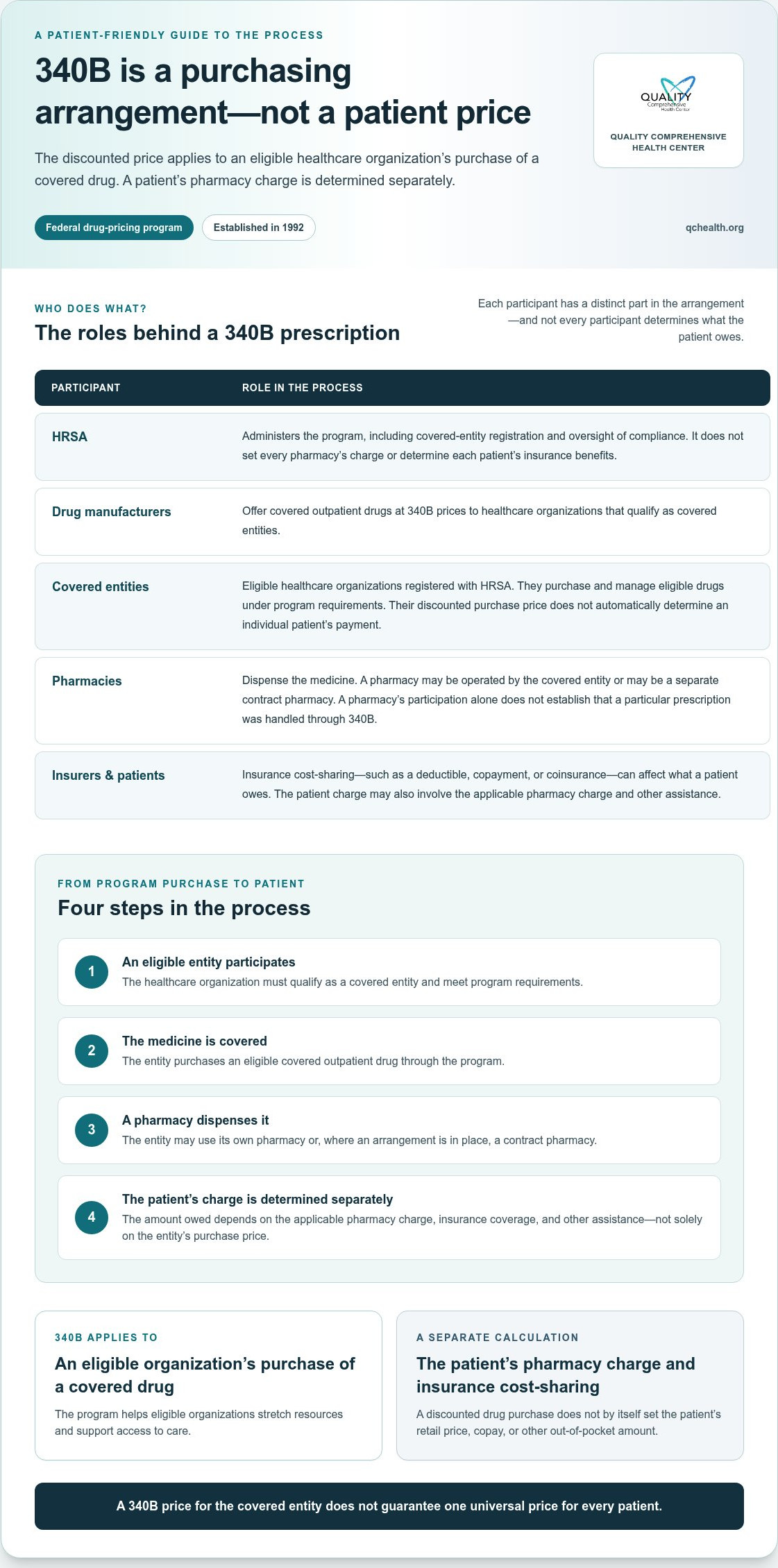
The 340b drug pricing program involves several steps before a patient receives a prescription. The discounted purchase price applies within the program; the pharmacy charge and any insurance cost-sharing are separate parts of the process.
An eligible entity participates. A healthcare organization must qualify as a covered entity and meet program requirements.
The medicine is covered. The entity purchases an eligible covered outpatient drug through the program.
A pharmacy dispenses it. The entity may use its own pharmacy or, where an arrangement is in place, a contract pharmacy.
The patient’s charge is determined. The amount the patient owes depends on the applicable pharmacy charge, insurance coverage, and other assistance, not solely on the entity’s purchase price.
In short, an eligible covered entity obtains a covered outpatient drug under 340B requirements, arranges for an eligible pharmacy to dispense it, and the patient’s final charge is determined separately from the entity’s discounted purchase price.
The roles of HRSA, covered entities, and drug manufacturers
HRSA administers the program, including covered-entity registration and oversight of compliance with program requirements. It does not set every pharmacy’s charge or determine each patient’s insurance benefits. Drug manufacturers provide eligible drugs at 340B prices under program rules, while covered entities are responsible for managing their participation and use of program drugs.
That division matters. The 340B purchase arrangement and an insurance plan’s benefit design are not the same thing. An insurer’s deductible, copayment, or coinsurance can affect what a patient owes, even when a drug was obtained at a discounted price by an eligible entity.
How pharmacies may fit into a 340B arrangement
An entity-operated pharmacy is run by the covered entity. A contract pharmacy is a separate pharmacy that has an arrangement with a covered entity to dispense drugs on its behalf. Such arrangements can help entities serve patients who use a community pharmacy, but they don’t mean every prescription filled there is a 340B prescription.
Covered entities must follow program requirements for their use of 340B drugs, including safeguards against diversion and duplicate discounts. The details depend on the arrangement and applicable rules. A pharmacy’s participation alone doesn’t establish that a particular medication or prescription was handled through 340B.
For patients, the practical takeaway is to separate the steps: who obtained the drug, where it was dispensed, and how the charge was calculated. In Charlotte, Quality Comprehensive Health Center provides community healthcare and pharmacy services. Explore community healthcare and pharmacy services to learn about care at QCHC.
Does 340B Guarantee Lower Prescription Costs? What Patients Should Know
No. The 340b drug pricing program does not create one universal price for every patient. It sets a discounted price for eligible covered entities purchasing certain drugs. A patient’s final charge is a separate matter and can depend on the pharmacy arrangement, insurance coverage, and any assistance that applies.
These amounts are related, but they aren’t interchangeable. A lower purchase price for a healthcare organization doesn’t automatically become a lower copay or cash price at the pharmacy.
340B purchase discounts versus what a patient pays
Think of the purchase price as one point in the process, not a promise about the final bill. The table separates the main terms patients may encounter:
For example, two people prescribed the same medicine may have different out-of-pocket charges because one uses insurance and the other does not, or because their coverage differs. A prescription filled at a pharmacy connected to a covered entity also isn’t automatically a 340B prescription.
Common 340B misunderstandings and limitations
340B is not a prescription card, insurance plan, or guaranteed discount applied at checkout. The eligibility of an organization, drug, and dispensing arrangement matters, and a pharmacy’s participation alone doesn’t establish how a specific prescription was priced.
The program’s operation is also debated. Manufacturers have raised concerns about program integrity and duplicate discounts, while covered entities have raised concerns about the effects of restrictions and administrative demands on their work. These are ongoing policy discussions, not proof that every patient’s price is higher or lower. If a charge is unclear, ask how your insurance was applied, whether the prescription was processed through a 340B arrangement, and whether separate assistance may be available.
How to Ask About 340B and Prescription Affordability
A confusing prescription charge can be stressful. You deserve a clear explanation, and asking questions doesn’t mean assuming a 340B discount should apply. The 340b drug pricing program has specific participation and dispensing rules, while your insurance and pharmacy arrangements can also shape what you owe.
Questions to ask about a prescription charge
Have your prescription information and insurance details nearby, then ask the pharmacy or care team to walk through the charge. These questions can help you identify what’s driving the amount:
How was this prescription processed? Ask whether it went through your insurance or another pharmacy arrangement, and whether the medicine is covered under your plan.
What part of the charge is my responsibility? Ask whether it reflects a deductible, copayment, coinsurance, or a medicine your plan doesn’t cover.
Is there another option? Ask whether patient assistance may be available or whether a clinically appropriate alternative could be discussed with your prescriber. Don’t change or stop a prescribed medicine without discussing it with your care team.
Can you explain the bill clearly? Request an itemized explanation if needed, including which parts come from the pharmacy charge and which come from your insurance coverage.
A 340B price paid by an eligible organization isn’t automatically the amount you pay. If someone mentions 340B, ask whether the specific prescription was handled through that arrangement and how your own coverage was applied.
If you’re balancing prescription expenses with other healthcare costs, this guide to medical care with a high-deductible plan offers related cost-navigation guidance.
Where to find reliable 340B information
For official program definitions and current rules, use the Health Resources and Services Administration’s 340B resources. HRSA administers the program, and its information can help clarify which organizations are eligible and how program requirements apply. A general explanation may not answer whether a particular prescription or pharmacy arrangement was handled through 340B, so focus questions about your own bill on its processing and coverage.
For broader local care-navigation context, read this guide to finding a Charlotte care center. Quality Comprehensive Health Center is a Charlotte nonprofit community healthcare organization offering pharmacy services alongside broader care. Explore community healthcare and pharmacy services as you consider your care needs.
340B and Community Healthcare in Charlotte: Connecting Affordability With Care
Prescription affordability is one part of staying connected to care. If the cost of a medicine makes it difficult to fill or continue a prescription, tell your healthcare team. Open conversations can help clarify the charge and identify what questions or options may be worth exploring. You don’t have to understand every pharmacy or insurance detail before raising the concern.
The 340b drug pricing program is one part of the broader conversation about access to medicines, but it doesn’t guarantee a particular patient price. Discussing affordability with your care team is useful whether or not a prescription involves 340B. Your insurance coverage, pharmacy arrangement, and the medicine prescribed can all matter.
Why medication affordability belongs in a broader care conversation
Cost concerns can influence whether someone picks up a prescription or keeps taking it as directed. If a medication feels unaffordable, let your healthcare professional know before making changes. They can help explain the prescription and discuss whether a clinically appropriate alternative or patient assistance option may be available. No option is right for everyone, and a healthcare professional can help weigh choices in light of your care needs.
It can help to bring the pharmacy receipt or insurance explanation of benefits to a conversation. Ask what the charge represents, how your plan was applied, and what next steps are available. Clear information supports shared decisions and helps keep medication concerns connected to your overall treatment plan.
Finding supportive healthcare resources in Charlotte
Quality Comprehensive Health Center is a Charlotte-based nonprofit community healthcare organization serving underserved populations since 2004. Its services include primary and specialty care, behavioral health, pharmacy, HIV prevention and treatment, and case management. Pharmacy and prescription fulfillment are part of a broader care setting, where medication questions can be considered alongside other healthcare needs.
In Charlotte, patients can bring medication questions into conversations about their broader care. Quality Comprehensive Health Center offers community-based pharmacy services alongside primary and specialty care, behavioral health, HIV prevention and treatment, and case management.
Understanding your options starts with a conversation. Explore Quality Comprehensive Health Center’s community-centered services and care information as you consider support for your health.
Take the Next Step Toward Clearer Prescription Conversations
The 340b drug pricing program helps eligible healthcare organizations access covered medicines at discounted purchase prices, but it doesn’t guarantee a lower bill for every patient. Your prescription charge can depend on how the medicine is dispensed, how your insurance applies, and whether other assistance is available.
Understanding those distinctions can help you ask clear questions about your pharmacy charge and discuss affordability concerns with your care team. You don’t have to sort through every detail alone.
Quality Comprehensive Health Center is a Charlotte-based community healthcare nonprofit serving underserved populations, with over 20 years of experience supporting the community. Pharmacy services are part of its broader approach to care. Connect with QCHC to explore community-centered healthcare and discuss your care needs.
Explore community-centered care and support at QCHC. Keep asking questions, share what you need, and take your next step toward care with confidence.
Frequently Asked Questions
What is the 340B Drug Pricing Program?
The 340B Drug Pricing Program is a federal program administered by the Health Resources and Services Administration (HRSA). Participating drug manufacturers offer eligible outpatient drugs at discounted prices to qualifying healthcare organizations, known as covered entities. The program is intended to help these organizations stretch resources for patient care. It isn’t health insurance or a prescription coupon, and it doesn’t guarantee every patient a particular price.
Who qualifies for the 340B program?
Eligible healthcare organizations that meet federal requirements and are recognized as covered entities may participate. Whether a specific patient or prescription is connected to a 340B arrangement depends on the organization’s relationship with the patient and applicable program rules. Receiving care at a clinic doesn’t automatically mean every prescription is handled through 340B. Ask about the specific medicine and dispensing arrangement if you’re trying to understand a particular charge.
Does 340B mean patients get cheaper prescriptions?
Not necessarily. The 340b drug pricing program sets discounted purchasing terms for eligible covered entities, not one required out-of-pocket price for every patient. Your charge may depend on your insurance, the pharmacy arrangement, the medicine, and other circumstances. If a bill is unclear, ask the pharmacy or care team to explain how the prescription was processed, how your coverage applied, and whether any assistance options may be available.
Can I use a 340B pharmacy without insurance?
Being uninsured doesn’t by itself determine whether a medicine is handled through a 340B arrangement. The covered entity, your relationship with it, the prescription, the pharmacy arrangement, and current program rules may all matter. If you don’t have insurance, ask the pharmacy or care team to explain the available payment options and the amount due before the prescription is filled. A 340B arrangement doesn’t guarantee a particular price.
How can I find out whether a prescription is connected to 340B?
Ask the dispensing pharmacy or healthcare organization whether the specific prescription was handled through a 340B arrangement, and request an explanation of the charge. Current HRSA resources can help you review official program information. Don’t infer participation from a low price, an organization’s nonprofit status, or its community healthcare mission. Those details alone don’t show whether a particular prescription was processed through 340B.
Does the 340B program cover every medication?
No. The program applies to eligible covered outpatient drugs purchased by covered entities under applicable requirements. Whether a specific medicine is included depends on the drug, the organization’s eligibility, the dispensing arrangement, and current program rules. Don’t assume every prescription from an organization that participates in 340B receives the same treatment. For a clear answer about a specific medicine, ask how that prescription was handled.
What should I do if I cannot afford a prescription?
Tell your healthcare team or pharmacy that cost is making it difficult to fill or continue your medicine. Ask for a clear explanation of the charge, how insurance was applied, and whether assistance or a clinically appropriate alternative may be available. Don’t stop or change prescribed treatment without discussing it with a qualified healthcare professional. In Charlotte, QCHC provides community-based healthcare, including pharmacy services as part of broader care.


Comments