
What to Do When Insurance Denies Your Medication: A 2026 Patient Advocacy Guide
- QCHC Communications

- Jun 6
- 12 min read
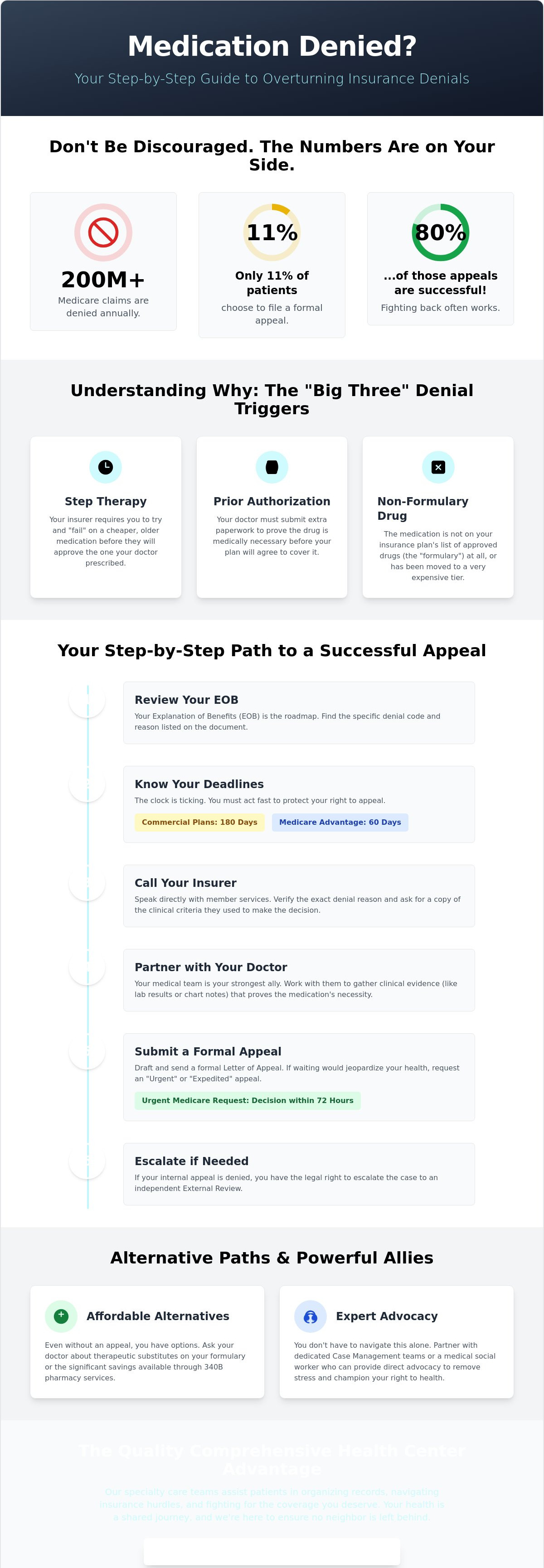
Over 200 million Medicare claims are denied every year, yet only 11% of patients choose to file a formal appeal. Even more striking is that those who do fight back win their cases roughly 80% of the time. If you've been told your prescription isn't covered, you aren't powerless. Knowing exactly what to do when insurance denies medication is the first step toward reclaiming your health and your peace of mind.
It's terrifying to stand at a pharmacy counter and realize you might miss a dose. We understand the stress of navigating confusing terms like step therapy or high out-of-pocket costs. You shouldn't have to choose between your finances and your physical well-being. We're here to help you identify the denial, document the necessity, and submit the appeal. This guide promises to simplify the 2026 insurance landscape so you can get the treatment your doctor prescribed without the fear of a health decline.
We will preview the latest 2026 Medicare decision timelines and show you how to find lower-cost alternatives through 340B programs. You'll also learn how a medical social worker can provide the personal Advocacy needed to navigate these hurdles. Your Health is a shared journey; we're here to ensure no neighbor is left behind.
Key Takeaways
Identify the "Big Three" reasons for coverage denials—Step Therapy, Prior Authorization, and Non-Formulary status—to unlock the right path forward for your treatment.
Learn exactly what to do when insurance denies medication by coordinating with your doctor to submit a formal appeal backed by strong clinical evidence.
Navigate the Prior Authorization process with confidence by understanding how your medical team justifies your specific prescription needs to the insurer.
Secure your treatment through affordable alternatives, including therapeutic substitutes on your formulary and the significant savings available via 340B pharmacy services.
Partner with dedicated Case Management teams who provide direct Advocacy to remove the stress of insurance hurdles and champion your right to Health.
Table of Contents
Understanding Why Your Medication Was Denied: Common 2026 Triggers
How to Appeal a Denied Medication: A Step-by-Step Advocacy Path
Collaborating with Your Provider on Prior Authorizations and Exceptions
Exploring Affordable Alternatives When Insurance Coverage Fails
The QCHC Advantage: Personalized Support and Integrated Care
Understanding Why Your Medication Was Denied: Common 2026 Triggers
An insurance denial is a refusal of coverage, not a refusal of care. Your doctor still believes you need the treatment; the insurer simply refuses to pay for it at this moment. This distinction is the foundation of Advocacy. When you are standing at the pharmacy counter wondering what to do when insurance denies medication, remember that a "no" is often a clinical starting point. In 2026, most denials stem from three specific triggers: Step Therapy, Prior Authorization, and Non-Formulary status.
Step Therapy is a cost-saving tactic where insurers force you to try cheaper, older medications before they approve the one your provider actually ordered. It's often called "fail first" because you must literally fail to get better on a different drug before the insurance company relents. Prior authorization requires your doctor to submit extra paperwork to prove the drug is medically necessary before the plan will cover it. Finally, if a drug is Non-Formulary, it means it isn't on the insurer's approved list at all. Beyond these clinical hurdles, simple administrative errors like an incorrect billing code or a transposed digit in your member ID can trigger an immediate rejection.
Decoding Your Explanation of Benefits (EOB)
Your Explanation of Benefits (EOB) is the roadmap to your appeal. You must identify the specific denial code or reason listed on your insurance paperwork to move forward. It is vital to distinguish between a temporary pharmacy counter rejection, which might just be a missing signature, and a formal written denial. For most commercial plans in 2026, you have a 180-day deadline to file an appeal. Knowing what to do when insurance denies medication starts with tracking these dates closely so you don't lose your right to fight the decision.
Formulary Changes and Exclusions
A Formulary is the living list of drugs your plan covers. Insurers often remove drugs mid-year or move them to a different "Tier" based on new cost negotiations. These Tiered pricing structures significantly impact specialty medication accessibility, often shifting more of the financial burden onto the patient. When a drug is excluded or moved to a higher tier, it isn't just a budget issue; it's a barrier to your Health. Our mission is to help you navigate these shifts by identifying the underlying reason for the change and finding a path toward approval or a more affordable alternative.
How to Appeal a Denied Medication: A Step-by-Step Advocacy Path
The moment you receive a denial notice, the clock starts ticking. For most commercial plans, you have 180 days to act, but for Medicare Advantage, that window shrinks to 60 days. Understanding what to do when insurance denies medication requires a disciplined approach to documentation and communication. Start by calling your insurance company's member services department directly. You need to verify the exact reason for the denial and request a copy of the specific clinical criteria they used to make the decision. Don't rely on the pharmacy's brief explanation; get the details straight from the source.
Effective Advocacy depends on your partnership with your doctor. You must coordinate with your medical team to gather clinical evidence, such as lab results or chart notes, proving the medication's necessity. Once you have your evidence, submit a formal Letter of Appeal to the insurance company's appeals department. If your health would be jeopardized by waiting for a standard review, request an "Urgent" or "Expedited" appeal. Under 2026 rules, expedited requests for Medicare Advantage plans must receive a decision within 72 hours. If the internal appeal is denied a second time, you have the legal right to escalate to an External Review.
Managing these complex layers can feel overwhelming. Our specialty care teams often assist patients in organizing these records to ensure no detail is missed while fighting for coverage.
Filing an Internal Appeal with Your Insurer
Drafting a clear statement is your chance to humanize your medical needs. Explain why the preferred drug is essential for your specific condition and include documentation of any previous "failed" medications. This is particularly critical if step therapy was the primary reason for the rejection. You can find more detailed guidance on appealing prescription drug denials through federal training resources. Always keep a detailed log of every phone call. Record the date, the name of the representative you spoke with, and any reference numbers provided during the conversation.
Requesting an External Review in North Carolina
When internal appeals fail, an External Review offers a fresh perspective. Independent third-party doctors who don't work for the insurance company will review your case to determine if the medication is medically necessary. These reviews are legally binding for the insurance company. For Charlotte residents, the North Carolina Department of Insurance (NCDI) manages this process. You can reach their Health Insurance Smart NC division at 855-408-1212 to start your request. This step ensures that your Health is evaluated by medical professionals rather than administrative algorithms.
Collaborating with Your Provider on Prior Authorizations and Exceptions
Prior Authorization is essentially a requirement for your doctor to justify why a specific prescription is the right choice for your unique health needs. It's a clinical conversation between your provider and the insurer. When you are unsure what to do when insurance denies medication, your medical team becomes your strongest ally. They provide the clinical charts, lab reports, and diagnostic evidence required to meet the insurer's specific criteria. Proving necessity. Documenting history. Securing approval. This three-part approach is how we turn a rejection into an acceptance.
Sometimes, the standard list of drugs just doesn't work for a patient. If you have a unique medical condition or a severe allergy to a cheaper alternative, your provider can request a Formulary Exception. This allows you to access a medication that isn't typically covered by your plan. One of the most significant benefits of an integrated care model is how it streamlines these approvals. When your pharmacy and your doctor operate within the same system, the flow of information is seamless, reducing the time you wait for your life-saving treatment.
The Power of Clinical Documentation
Clinical documentation is the backbone of every successful appeal. Specific lab results or a documented history of severe side effects from other medications can help you bypass step therapy entirely. We advise all patients to share their full medical history, including past prescriptions that didn't work, to help us build a stronger case for coverage. Our specialty care providers are particularly skilled at handling high-complexity requests for chronic conditions. Your detailed history is the key to proving that your current prescription isn't a luxury; it's a medical requirement.
Requesting a Peer-to-Peer Review
A Peer-to-Peer Review is a high-level advocacy move where your doctor speaks directly to the insurance company's medical director. This doctor-to-doctor talk can often resolve denials in minutes because it moves beyond automated systems and basic paperwork. It allows your provider to explain the clinical nuances of your case that a computer might miss. If you are stuck wondering what to do when insurance denies medication after a standard appeal fails, ask your clinic if they offer this service. Direct clinical advocacy is often the final hurdle to getting your medication approved.
Exploring Affordable Alternatives When Insurance Coverage Fails
Sometimes an appeal takes time that your health simply doesn't have. If you are stuck wondering what to do when insurance denies medication while facing an empty pill bottle, you need immediate financial solutions. Advocacy isn't just about fighting a "no"; it's about finding a "yes" through alternative pathways. Start by asking your pharmacist for therapeutic alternatives already on your plan’s formulary. These are different drugs that treat the same condition but are preferred by your insurer. Often, a quick switch to a preferred brand or a generic version can lower your costs from hundreds of dollars to a standard copay.
For specialty drugs that lack generic versions, look toward the manufacturers themselves. Many pharmaceutical companies offer "Manufacturer Copay Cards" that can reduce out-of-pocket costs to nearly zero. These are essentially coupons that pay the bulk of your pharmacy bill. Additionally, Patient Assistance Programs (PAPs) provide long-term support for those who qualify based on income. We believe that financial status should never dictate your quality of life. Our integrated pharmacy services are designed to help you identify these programs the moment a denial occurs.
Leveraging the 340B Drug Pricing Program
The 340B Drug Pricing Program is a federal lifeline that allows community health centers to purchase medications at significant discounts. We pass these savings directly to you. This is a vital resource for neighbors navigating a high deductible plan where initial costs are often prohibitive. Because 340B savings are tied to the facility rather than your specific insurance plan, they are often available regardless of your coverage status. If you live in Cabarrus County, utilizing 340B pharmacy services in Concord, NC can be the difference between missing a dose and maintaining your Health.
Accessing Manufacturer Patient Assistance Programs (PAPs)
Patient Assistance Programs are separate from insurance and are managed directly by drug makers. These programs provide free or low-cost medication to eligible patients who demonstrate a clear need. Common eligibility factors include your annual income level, a lack of insurance, or facing high out-of-pocket costs that exceed your ability to pay. To find these, search for your specific "drug name + patient assistance" on the manufacturer’s website. Most applications require a signature from your doctor, which our team provides as part of our commitment to your Advocacy. These programs represent a collaborative effort between providers and manufacturers to ensure that life-saving treatment remains within reach for everyone in our community.
The QCHC Advantage: Personalized Support and Integrated Care
At Quality Comprehensive Health Center (QCHC), we believe that a prescription is a promise of better Health. When that promise is blocked by an insurance company, it creates a gap in care that can have devastating consequences for our neighbors. Our mission is centered on eliminating health disparities through direct, relentless Advocacy. We don't just provide clinical services; we act as a foundational civic pillar for our community. Knowing what to do when insurance denies medication shouldn't be a burden you carry alone. It's a challenge we meet together.
Our Case Management team is specifically trained to take the administrative weight off your shoulders. We understand that navigating insurance jargon and deadlines is exhausting, especially when you're already feeling unwell. By stepping in to handle the communication with insurers, we ensure that your medical needs are translated into the language that insurance companies understand. This includes the essential role of Charlotte medical social worker services, which provide a bridge between your clinical treatment and the social resources you need to stay healthy. We're here to lower the barriers to healthcare by being personally attentive to every detail of your case.
Case Management and Advocacy in Charlotte
Our staff communicates directly with insurers on your behalf to resolve disputes quickly. We provide wraparound support that goes beyond simple paperwork. This includes identifying grant programs, manufacturer assistance, and other funding sources for expensive medications that might otherwise be out of reach. We invite all patients facing coverage hurdles to schedule a consultation with our team to review medication access options. We'll look at your specific plan and build a personalized plan to secure your treatment. When you're unsure what to do when insurance denies medication, our team provides the clarity and action needed to move forward.
Holistic Care for Chronic Conditions
Medication access is a critical component of successful chronic disease management. Whether you're managing diabetes, hypertension, or behavioral health needs, missing even a single dose can set back months of progress. Because we prioritize your long-term success, we offer comprehensive help navigating the healthcare system. This integrated approach ensures that your primary care, specialty care, and pharmacy needs are all pulling in the same direction. Advocacy is a Core Principle of our clinical Excellence because we know that Health is a shared responsibility. You are a valued member of our community, and we are committed to ensuring you never have to fight for your well-being in isolation.
Take Charge of Your Treatment Journey
A medication denial is a hurdle, but it isn't the end of your care. You now have the tools to decode your EOB, partner with your provider for peer-to-peer reviews, and access 340B savings. Advocacy is about persistence; it's about documentation; it's about knowing your worth as a patient. Understanding what to do when insurance denies medication allows you to move from confusion to clear, decisive action. You have the right to the treatment your doctor prescribed.
With over 20 years of community advocacy, QCHC stands as a foundational pillar for Charlotte families. Our dedicated Medical Social Workers are ready to step in and fight for your coverage. We provide 340B Pharmacy pricing to ensure eligible patients never miss a dose due to financial strain. Your Health is a shared responsibility, and we're honored to carry that weight with you. Let our Case Managers help you navigate your medication denial—contact QCHC today.
Stay strong. Stay informed. Your well-being is worth the effort, and we're here to ensure you receive the clinical Excellence you deserve.
Prescription Coverage: Frequently Asked Questions
What is the most common reason insurance denies a medication?
The most frequent reason for a coverage denial is the requirement for Prior Authorization. This means your insurer needs extra documentation from your doctor to justify the cost and medical necessity of the drug. Other common triggers include step therapy, where you must try cheaper drugs first, or the medication simply not being on your plan's formulary. Simple administrative errors like incorrect billing codes are also frequent culprits.
How long does the medication appeal process usually take?
In 2026, standard prior authorization decisions for Medicare Advantage must be made within 7 calendar days. If you file an expedited appeal because your health is at risk, insurers are required to provide a decision within 72 hours. Commercial plans like Aetna or Cigna often have different internal timelines, but they generally resolve standard appeals within 30 to 60 days. Keeping a log of all communication helps track these deadlines.
Can my doctor change the prescription to something insurance will cover?
Yes, your provider can often switch you to a therapeutic alternative that is already on your plan's formulary. These are different medications that treat the same condition but are preferred by your insurance company. This is often the fastest way to ensure you don't miss a dose while avoiding the lengthy appeals process. Always discuss these options with your doctor to ensure the substitute is safe and effective for your specific condition.
What should I do if I run out of medication while waiting for an appeal?
If you are out of medication, contact your doctor immediately to ask for professional samples or an emergency short term supply. You can also explore local resources like 340B pharmacy programs that offer deep discounts regardless of insurance status. Knowing what to do when insurance denies medication in an emergency is vital. Our case managers can often help you find bridge funding or manufacturer programs to cover costs during the review period.
Is there a difference between a Prior Authorization and an Appeal?
A Prior Authorization is a request for approval before you fill the prescription, while an Appeal is a formal challenge to a decision that has already been made. Think of the PA as the insurer's "permission" stage and the appeal as your "legal right" to dispute a denial. If your PA is rejected, the next step is to file an internal appeal to have that decision reconsidered by the insurance company's clinical team.
What happens if my insurance denies my medication after an external review?
An external review is typically the final step in the formal appeals process and its decision is legally binding for the insurer. If the denial is upheld, you may need to work with your doctor to find a different clinical path or look for outside financial assistance. Programs like Patient Assistance Programs (PAPs) or community health center discounts become essential lifelines when traditional insurance coverage is no longer an option for your specific treatment.
Can a medical social worker help me if I am uninsured?
Absolutely. Medical social workers are dedicated to helping all neighbors access care, regardless of their insurance status. They specialize in finding state funded programs, pharmaceutical manufacturer assistance, and local community resources that provide free or low cost treatment. At QCHC, our social workers act as your personal advocate to ensure that financial barriers don't prevent you from receiving life saving medication or essential specialty care. We believe health is a shared responsibility.
How do I find out if my medication is on my plan's formulary?
You can find your plan's formulary by logging into your insurance company's member portal and using their "Drug Search" or "Price a Medication" tool. Most insurers also mail a physical copy of the formulary during open enrollment, though the online version is updated more frequently. If you're still unsure, call the member services number on the back of your insurance card and ask specifically which Tier your medication falls under to understand your costs.


Comments