
What to Do After a Positive STD Test: Your Compassionate 2026 Guide to Healing
- QCHC Communications

- 1 day ago
- 12 min read
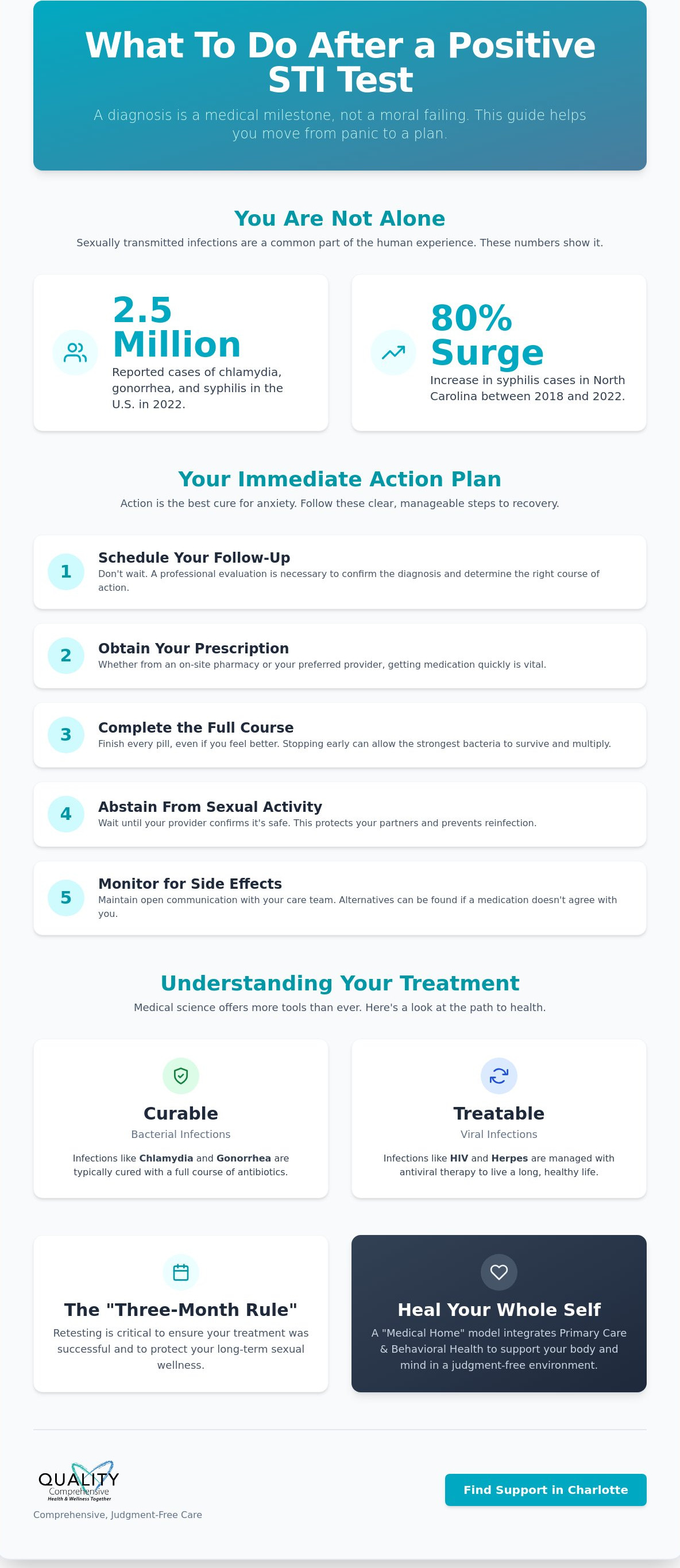
You're staring at the screen, your heart is racing, and the word "positive" feels like it's vibrating off the page. It's completely normal to feel a sudden wave of anxiety or a fear of judgment. You aren't alone in this moment; in fact, there were 2.5 million reported cases of STIs in the U.S. in 2022 alone. Understanding what to do after a positive STD test is the most important step you can take toward reclaiming your peace of mind and your health.
We believe that a diagnosis is a medical milestone, not a moral failing. This guide helps you move from panic to a plan by validating your feelings, explaining your treatment, and protecting your future. We'll walk through the latest 2026 treatment updates, including the use of Lentocilin for syphilis and the benefits of Doxy PEP. You'll also find practical scripts for talking to partners and a roadmap for finding a supportive, judgment-free clinic in Charlotte. Your healing starts with one confident step, and we're here to walk it with you.
Table of Contents
Processing Your Results: Understanding Your Diagnosis Without Judgment
Receiving a positive result can feel like the world just stopped. It's a heavy moment, often filled with a rush of questions and a surge of adrenaline. But in 2026, a positive test is simply a manageable health event. It is not a reflection of your character. It is not a permanent label. It is a signal that your body needs specific, professional care. At Quality Comprehensive Health Center, we treat the person sitting in front of us, not just the lab result. Our philosophy centers on dignity, respect, and total wellness.
Gaining a clear perspective through Understanding Sexually Transmitted Infections is the first step toward clarity. These infections are a common part of the human experience. When you're deciding what to do after a positive STD test, start by breathing. You are still the same person you were before the test. You are worthy of care. You are worthy of health. You are worthy of a future free from shame.
Normalizing Sexual Health in Our Community
Sexually transmitted infections don't discriminate. In 2022, the CDC reported 2.5 million cases of chlamydia, gonorrhea, and syphilis nationwide. In North Carolina, we see these same trends. Syphilis cases alone surged 80% between 2018 and 2022. This data shows that you are part of a large community navigating these same challenges. A diagnosis does not define your worth. It just means you have a new priority for a few weeks. Because your mind is just as important as your body, prioritizing a mental health check-in Charlotte can provide the emotional anchor you need right now. Heal the body. Quiet the mind. Restore the spirit.
Immediate Self-Care and Mindset Shifts
Stop the blame game. It's easy to spiral into "what ifs" or point fingers at past partners. This serves no one. Remember that many STIs are completely asymptomatic. A partner might have had no idea they were carrying an infection. Instead of looking backward, look forward. Shift your mindset toward proactive healing. Focus on your recovery plan. Focus on your Community support. By knowing exactly what to do after a positive STD test, you take the power back from the diagnosis. You move from being a patient to being a person in charge of their wellness. We are here to ensure that your journey back to health is supported, private, and fast.
Immediate Medical Steps: Treatment and Prescription Adherence
Action is the best cure for anxiety. Once you have your results, the path forward is a series of clear, manageable steps. Knowing exactly what to do after a positive STD test replaces fear with a concrete plan for recovery. Your health is a priority. Your privacy is a promise. By following a structured medical protocol, you ensure that the infection is handled effectively and permanently.
Schedule your follow-up immediately. Don't wait for symptoms to change. A professional evaluation is necessary to confirm the specific strain of the infection and determine the right course of action.
Obtain your prescription through a trusted source. Whether it's our on-site pharmacy or your preferred local provider, getting your medication quickly is vital.
Complete the full course. Even if you feel better after 48 hours, finish every pill. Stopping early allows the strongest bacteria to survive and multiply.
Abstain from sexual activity. You must wait until your provider confirms it's safe. This protects your partners and prevents you from being reinfected while your immune system is recovering.
Monitor for side effects. Maintain open communication with your Care team. If a medication doesn't agree with you, we can often find an alternative that works better for your body.
Understanding Your Medication Plan
In 2026, medical science offers more tools than ever. We follow the latest CDC Treatment Guidelines to ensure you receive the most advanced care. This includes the use of Doxy PEP for bacterial prevention and the temporary importation of Lentocilin to address syphilis medication shortages. It's important to distinguish between "curable" and "treatable." Bacterial infections like chlamydia or gonorrhea are curable with antibiotics. Viral infections like HIV or herpes are treatable, meaning we use antiviral therapy to manage the virus so you can live a long, healthy, and vibrant life. Our pharmacy services are integrated into your care to ensure you get exactly what you need without delay.
Accessing Care Regardless of Insurance Status
Financial stress should never be a barrier to healing. Many of our neighbors are currently navigating how to get medical care with a high deductible plan or managing health needs without any insurance coverage. We offer a sliding fee scale for uninsured patients to keep our services accessible to the entire Charlotte community. We also maintain strict confidentiality protocols, especially for teen health and sensitive services. You deserve high-quality care that respects your budget and your privacy. If you are unsure about your coverage, our team can help you find a path forward that fits your life. You can schedule a confidential consultation today to discuss your options with a provider who cares.
Navigating Partner Notification and the Emotional Impact
Telling a partner about your diagnosis is often the most stressful part of deciding what to do after a positive STD test. It's a moment that requires immense courage. We view partner notification not as a chore of shame, but as a profound act of Care and Community responsibility. By sharing this information, you're giving someone else the power to protect their own health. You're breaking the cycle of infection and preventing long-term complications for someone you've shared an intimate connection with.
Preparation is key to a productive conversation. Choose a private, quiet space where you won't be interrupted. Be direct. Be honest. Stick to the medical facts. If you feel that a direct conversation might compromise your physical safety, there are anonymous notification tools available that can send a text or email to your partners without revealing your identity. Your safety is our primary concern. Whether you choose a face-to-face talk or an anonymous service, taking this step is a vital part of your personal healing journey.
Scripts for a Difficult Conversation
Having the right words can lower the temperature of a tense moment. For a current partner, try a direct approach: "I'm telling you this because I care about our health. I recently went for a check-up and my results came back positive for [infection]. I've already started my treatment plan, but you need to get tested as soon as possible so we can both be healthy."
For casual or past encounters, a simple text is often sufficient: "Hey, I wanted to let you know that I recently tested positive for [infection]. You might want to get screened just to be safe." This isn't about looking back; it's about looking forward. For future peace of mind, you can also explore our guide on how often should I get tested for STDs to build a sustainable wellness routine.
Integrating Behavioral Health into Your Recovery
True healing goes beyond a prescription bottle. When you are navigating what to do after a positive STD test, your mental health deserves as much attention as your physical symptoms. It's normal to feel anxious, frustrated, or even isolated. Our Behavioral Health services are designed to support you through these emotional waves. We provide a judgment-free space to discuss relationship strain and self-image. At Quality Comprehensive Health Center, we believe that sexual health excellence requires a holistic approach. We treat the whole person, ensuring that your mind is as resilient and healthy as your body. You are not alone in this; our entire team is here to support your total Wellness.
Retesting and Protecting Your Long-Term Sexual Wellness
Your journey back to health doesn't end when you swallow the last pill in your prescription bottle. True healing requires follow-through. When you are determining what to do after a positive STD test, retesting is the bridge between temporary treatment and long-term vitality. It confirms the infection is gone. It ensures you haven't been reinfected. It gives you the green light to move forward with absolute confidence in your body.
We strictly follow the "Three-Month Rule." For common infections like chlamydia, gonorrhea, and syphilis, the CDC recommends a follow-up test approximately 90 days after you complete treatment. This isn't because the medicine didn't work. It's because reinfection rates are surprisingly high, often occurring when a partner hasn't been treated or a new exposure happens shortly after recovery. Understanding the window period is also vital. Testing too soon can lead to misleading results. Wait for the specific timeline your provider sets to ensure your labs are accurate and clear.
Protection in 2026 is a multi-layered strategy. We help you build a toolkit that fits your lifestyle. This includes:
Consistent barrier use, such as condoms and dental dams, to reduce skin-to-skin transmission.
Biomedical prevention like PrEP (Pre-Exposure Prophylaxis) for ongoing HIV protection.
Emergency PEP (Post-Exposure Prophylaxis) if you believe you've had a high-risk exposure.
Doxy PEP for those at increased risk of bacterial STIs.
Regular, scheduled screenings to catch any issues early.
Building a Sustainable Wellness Routine
Your sexual health is a core pillar of your overall physical and emotional vitality. Scheduling regular check-ups shouldn't be a source of stress or an afterthought. This is exactly why your primary doctor is important for your health in the long run. A dedicated provider knows your history. They can advocate for your specific needs. By integrating sexual health into your routine Primary Care, you remove the stigma and replace it with a standard of excellence. You deserve a Medical Home where every part of you is cared for under one roof.
Public Health and Reporting: What You Should Know
In North Carolina, certain infections are reportable by law to the Department of Public Health. This includes syphilis, gonorrhea, chlamydia, and HIV. This process helps the state track trends and allocate resources to protect the Charlotte community. It's a standard public health protocol, not a personal judgment. Your information remains protected by strict privacy laws. We ensure that your data is handled with the highest level of confidentiality while fulfilling our duty to keep our neighbors safe. Schedule. Screen. Stay healthy. You can book your follow-up screening with our team today to ensure you stay on the path to total health.
Comprehensive, Judgment-Free Care at Quality Comprehensive Health Center
For over 20 years, Quality Comprehensive Health Center has stood as a foundational civic pillar on Beatties Ford Road. We aren't just a clinic; we're a neighbor. When you're determining what to do after a positive STD test, you deserve more than a cold examination room. You deserve a safe space where your dignity is the priority. Our mission is to lower the barriers to healthcare by providing excellence that is both technologically advanced and deeply human. We believe that health is a shared responsibility, and we're committed to walking this path alongside you.
We operate under a "Medical Home" model. This means your Primary Care, Pharmacy, and Behavioral Health services are all integrated under one state-of-the-art roof. This holistic approach ensures that no part of your recovery is overlooked. For marginalized populations in Charlotte, this model is a promise of health equity. It's about showing every patient that they're worthy of the highest standard of care, regardless of their background or insurance status. We exist to empower our clients, providing them with the tools to live vibrant, healthy lives.
The QCHC Difference: Holistic and Innovative
Our practitioners take personal accountability for your Wellness. We don't just treat infections; we work to eliminate health disparities in the Charlotte community. By integrating clinical expertise with humanitarian empathy, we provide a path to recovery that feels supported and certain. Healing the body. Restoring the spirit. Uplifting the Community. This three-part commitment drives every interaction within our walls. Consulting with our expert practitioners ensures you receive a personalized plan that respects your unique life circumstances and health goals.
Next Steps: How to Connect with Us
Taking the next step is simple, direct, and confidential. You don't have to navigate this diagnosis alone. Whether you need an immediate follow-up appointment, a prescription refill from our pharmacy, or a supportive counseling session, our team is ready to welcome you. Scheduling your visit. Receiving your care. Reclaiming your life. Locating our Charlotte care center is the first move toward long-term peace of mind. We are conveniently located to serve our neighbors with the respect and excellence they deserve.
Knowing what to do after a positive STD test is about taking control of your future. Your diagnosis is a single chapter, not the entire book. We invite you to join a collective effort toward better health for everyone. Your health is your right; let us help you protect it. Healing starts with the individual and ends with a healthier us.
Reclaiming Your Health and Peace of Mind
Your health journey is defined by intentional choices and resilient steps. You've learned that a positive diagnosis is simply a manageable medical milestone, and that prompt treatment combined with the "Three-Month Rule" for retesting ensures your long-term vitality. By choosing to notify partners, you've transformed a difficult moment into a courageous act of Community Care. Knowing what to do after a positive STD test empowers you to move forward with absolute confidence and clarity. You are more than a test result; you are a vital member of our community.
At Quality Comprehensive Health Center, we've spent over 20 years providing judgment-free, affirming care to our neighbors from our state-of-the-art facility on Beatties Ford Road. We believe that everyone deserves a Medical Home where their worth is celebrated and their health is protected. You don't have to walk this path alone. Our expert practitioners are ready to provide the compassionate support and advanced medicine you need to thrive.
Schedule Your Confidential Follow-Up at QCHC Today. Your future is bright, your health is your right, and our team is here to help you protect it. Healing starts with you, but it's sustained by us all.
Frequently Asked Questions
Will my positive STD test result stay on my permanent medical record?
Your test results are protected by strict federal privacy laws like HIPAA. While they remain part of your confidential clinical history at the facility where you were tested, they cannot be shared with employers or outside parties without your explicit written consent. Keeping an accurate record ensures your practitioners can offer the most effective long-term care for your specific health needs.
How long do I have to wait to have sex after finishing my treatment?
You should typically wait seven days after completing a single-dose treatment or until you finish the final pill of a multi-day course. This waiting period is critical to ensure the medication has fully cleared the infection from your system. Engaging in sexual activity too early increases the risk of reinfection or passing the infection to others, even if you no longer have symptoms.
What happens if I cannot afford the medication prescribed for my STI?
We provide a sliding fee scale and integrated pharmacy assistance programs to ensure no neighbor is turned away due to an inability to pay. If you are worried about what to do after a positive STD test because of costs, please speak with our financial counselors immediately. Access to medicine is a fundamental principle of health equity, and we will find a solution that fits your budget.
Can I get an STD again if I have already been treated for it once?
Yes, you can be reinfected with the same STI even after successful treatment. Most sexually transmitted infections do not provide permanent immunity to your system. This makes consistent barrier use and regular screenings essential. Protecting your future wellness requires a proactive approach to prevention, even after you have cleared a previous infection.
How does the health department contact my partners if I test positive?
Health department staff, known as Disease Intervention Specialists, can contact your partners anonymously to notify them of a potential exposure. They never share your name, your gender, or the date of your test during this process. This professional outreach is a vital public health strategy designed to stop the spread of infections while keeping your identity completely private and secure.
Is a positive test result always accurate, or should I get a second opinion?
Modern diagnostic tests are highly accurate, though no medical test is perfect. If you are asymptomatic or believe there has been a laboratory error, a confirmatory test can be performed to provide absolute certainty. Our practitioners always review your specific results alongside your clinical history to ensure your diagnosis is correct before you begin any medication plan.
What if my partner refuses to get tested or treated?
You cannot control a partner's choices, but you must prioritize your own protection. Avoid sexual contact with them until they have been professionally cleared, as you are at high risk for immediate reinfection. In certain situations, we can offer Expedited Partner Therapy, which allows us to provide a prescription for your partner without them needing a separate office visit.
Are there specific STIs that cannot be cured, only managed?
Viral infections like HIV, herpes, and HPV are currently managed with advanced therapies rather than cured. While bacterial infections like chlamydia are cleared with antibiotics, viral STIs require a long-term Care plan to maintain your health and reduce transmission risk. Knowing what to do after a positive STD test involving a virus is the first step toward a long, vibrant, and healthy life.


Comments