


How to Talk to Your Partner About STD Results: A Compassionate Guide

What if an STD diagnosis wasn't a character judgment, but a clinical fact that could actually strengthen your bond? We know that receiving a positive test result can feel like a heavy weight. You might be feeling a sense of shame or a deep fear that your relationship won't survive the news. It's natural to feel anxious about how to talk to your partner about STD results when you're worried about their reaction or confused by medical terminology.
We believe that every patient deserves compassionate care and clear information. You don't have to carry this burden alone. We'll show you how to turn a difficult conversation into a shared health strategy that protects both of you. You'll learn the practical steps to ensure both partners get treated, including understanding current CDC guidelines and the 2026 FDA updates on medication availability. This guide provides the emotional tools you need to reduce anxiety and move forward together. We are dedicated to serving you and OUR COMMUNITY with the Quality care you deserve.
Key Takeaways
Learn to reframe an STD diagnosis as a manageable medical condition rather than a moral failing to protect your relationship and mental well-being.
Master the emotional and practical steps of how to talk to your partner about STD results by leading with empathy and sticking to the clinical facts.
Prepare for a range of emotional reactions by understanding how to explain medical latency and the complex timing of infections.
Coordinate a shared treatment plan that includes immediate partner testing and options like Expedited Partner Therapy to prevent reinfection.
Access high-quality, compassionate care at QCHC, where we provide specialized medical services and affordable testing for our entire Community.
Table of Contents
Preparing for the Conversation: Mindset and Facts
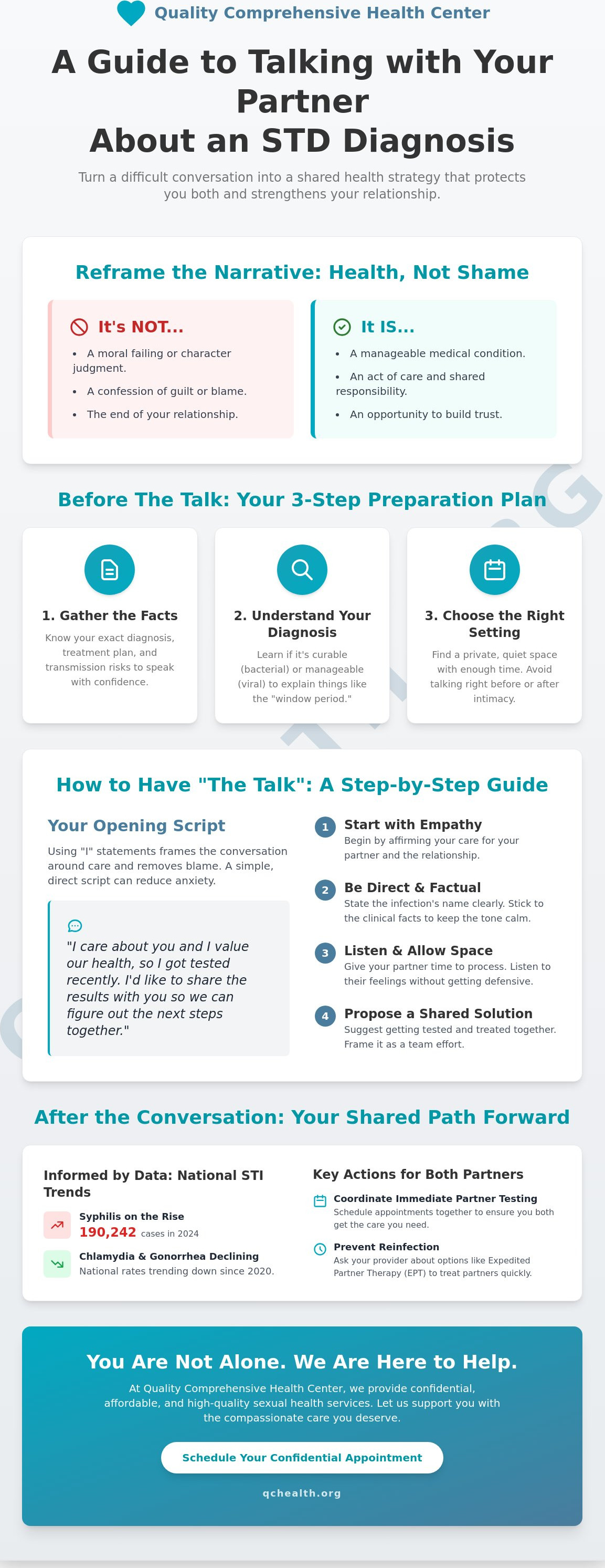
We believe that your health status doesn't define your worth as a person or a partner. An STD diagnosis is a manageable medical condition, not a moral failing. When you approach this news as a shared health strategy rather than a confession of guilt, you lower the emotional barriers for everyone involved. It's about protecting the people we care about and ensuring our Community stays healthy. Shifting your mindset from shame to advocacy allows you to focus on what matters most: transparency and treatment.
Before you sit down to talk, gather every piece of clinical information you have. You should know the exact name of the infection and the treatment plan your doctor recommended. If you aren't sure about the specifics, consult with your provider at Quality Comprehensive Health Center. Our team, including Dr. Jerry Saunders and Dr. Ra'Shawn D. Flournoy, is here to clarify transmission risks so you can speak with confidence. Having these facts ready is the first step in learning how to talk to your partner about STD results without letting anxiety take over the conversation.
Understanding Your Diagnosis and Transmission
It's vital to know whether you're dealing with a bacterial infection that is curable or a viral one that requires ongoing management. Clinical data from early 2026 confirms that while national rates for chlamydia and gonorrhea have declined since 2020, syphilis cases continue to rise across the country. In 2024 alone, reported syphilis cases reached 190,242. Understanding these Sexually transmitted infections (STIs) helps you explain the "window period" to your partner. This is the time between exposure and a positive test result. Knowing this helps explain why you might have tested negative in the past or why you didn't have symptoms immediately. As of March 6, 2026, the FDA even allows the temporary importation of medications like Lentocilin to ensure patients get the Quality care they need despite national shortages.
Choosing the Right Time and Place
Timing is everything. Select a private, quiet setting where you won't be interrupted by phones, pets, or work obligations. We recommend avoiding this conversation immediately before or after sexual intimacy. Emotions and physical vulnerability are already high in those moments, which can lead to unnecessary tension. Ensure you have enough time for a long, honest discussion. Don't try to squeeze this news into a lunch break or right before one of you leaves for a shift. When you provide a safe, unhurried space, you show your partner that you value their feelings and the relationship. This preparation is a key part of how to talk to your partner about STD results while maintaining trust and mutual respect.
A Step-by-Step Guide to Having "The Talk"
We believe that honesty is the foundation of any healthy partnership. Once you've gathered your facts, the next step is figuring out exactly how to talk to your partner about STD results in a way that preserves trust. This conversation isn't about assigning blame; it's about mutual protection and moving forward together. By framing the news as a shared health strategy, you transform a stressful moment into an act of care for your partner and our Community. Honesty builds trust. It creates a safe space where both of you can focus on the medical solution rather than the emotional weight of the diagnosis.
Lead the discussion by emphasizing the value of your relationship. When you are deciding how to talk to your partner about STD results, remember that your tone sets the stage for their reaction. When you approach the topic with a calm, non-defensive posture, it helps your partner stay grounded as well. Give them your full attention and allow space for them to process the information without interruption. After you've shared the news, offering a collaborative solution is the best way to maintain your bond. You might suggest visiting a Charlotte clinic together to ensure you both receive the Quality care you deserve. Approaching this as a team makes the path to recovery much smoother.
Starting the Conversation with Empathy
Use "I" statements to own your health status while keeping the focus on your shared safety. This prevents your partner from feeling attacked or accused. A simple, direct script can help: "I care about our health, so I went to get tested and wanted to share my results." This approach shows you're taking personal accountability and prioritizing their well-being. If you're feeling nervous, it's often helpful to talk to your partner about getting tested together as a routine part of your relationship maintenance. We are dedicated to helping you find the right words to protect those you love.
Being Direct and Honest About Results
State the specific name of the infection clearly, whether it's Chlamydia, Gonorrhea, or HSV-2. Avoid using loaded language or vague terms that could cause confusion. You should also explain that many infections are completely asymptomatic. For example, CDC data from 2024 shows there were approximately 1.5 million cases of chlamydia and 543,409 cases of gonorrhea in the United States. Many of these individuals had no idea they were carrying an infection for months or even years. Sharing this context helps your partner understand that a positive result doesn't necessarily mean a recent exposure. End by sharing the treatment plan your provider has already recommended. If you need help coordinating these next steps, our team at Quality Comprehensive Health Center is always available for scheduling a screening or a consultation to discuss your options together.
Navigating Partner Reactions and Objections
We understand that this is the moment many people dread. When you're figuring out how to talk to your partner about STD results, you're often more worried about their reaction than the infection itself. It's common for partners to experience a range of emotions, including shock, anger, fear, or even a strange sense of relief that they finally have an answer for persistent symptoms. Remember that their initial reaction is a physiological response to stress, not necessarily a permanent judgment of you or the relationship.
We believe in treating every patient with dignity and providing the tools to handle these difficult moments. If your partner becomes defensive or accusatory, stay grounded in the clinical facts we've discussed. Reiterate that this is a health hurdle to clear together. It's an opportunity to strengthen your mutual commitment to safety. By focusing on the solution rather than the source, you can steer the conversation toward a shared health strategy that protects your future.
Managing Fear and Misconceptions
Fear often stems from a lack of information. Your partner might have outdated ideas about how infections spread, such as myths about toilet seats or casual contact. You can provide clarity by sharing resources from the CDC or the specific guidance provided by our team at Quality Comprehensive Health Center. For example, explain that while national rates for some infections are dipping, syphilis cases rose by 42% between 2020 and 2024. This shows that STIs are a widespread Community health challenge. To lower the barriers to understanding, offer to have your partner join a follow-up consultation with Dr. Jerry Saunders or Dr. Ra'Shawn D. Flournoy. Hearing the facts directly from a medical professional can demystify the diagnosis and reduce personal anxiety.
Addressing Questions of Trust and Fidelity
The most common question you'll face is, "Where did this come from?" It's vital to explain that a positive result today does not automatically mean a recent exposure. Many infections are experts at staying hidden. For instance, syphilis cases have reached 190,242 annually as of 2024, and many of those individuals were asymptomatic for long periods. Latency means an infection could have been contracted months or even years ago. Focus the conversation on the "now" and the immediate steps required to protect each other. If the news causes a significant relational rift, we are dedicated to your total well-being. We suggest utilizing our behavioral health services to help navigate the emotional fallout and rebuild trust in a safe, supportive environment.
Moving Forward: Shared Health and Treatment Plans
We believe that a diagnosis is not the end of the story, but the beginning of a proactive health journey. Once you have navigated the initial hurdles of how to talk to your partner about STD results, the focus must shift immediately to coordinated action. The primary goal is to prevent the "ping-pong" effect, where partners continuously reinfect one another because treatment wasn't synchronized. We are dedicated to ensuring that both you and your partner have the resources needed to clear the infection and protect your long-term wellness.
Taking this step together can actually strengthen your relationship. It transforms a private medical concern into a shared commitment to mutual safety. Our providers, including Dr. Jerry Saunders and Dr. Ra'Shawn D. Flournoy, emphasize that clinical success depends on both partners following the exact same treatment timeline. We recommend that your partner seeks testing immediately, even if they do not have any symptoms. In 2024, the CDC reported that nearly 1.5 million cases of chlamydia were diagnosed nationally, many of which were entirely asymptomatic. Proactive testing is the only way to be certain of your health status.
Expedited Partner Therapy (EPT) in North Carolina
North Carolina health regulations allow for a practice known as Expedited Partner Therapy (EPT) for specific infections. EPT allows healthcare providers to provide prescriptions or medications for the partner of a diagnosed patient without requiring that partner to have a prior medical exam. This is a vital tool for stopping the spread of infections like Chlamydia and Gonorrhea within our Community. At Quality Comprehensive Health Center, we can facilitate EPT to streamline the treatment process for your partner, ensuring they get the medication they need without delay. This is particularly helpful when a partner may face barriers to scheduling their own immediate appointment.
Safe Sex Practices During and After Treatment
Commitment to a "no-contact" period is essential for successful treatment. Most providers recommend waiting at least seven days after finishing all prescribed medications before resuming any sexual activity. If you are treating a syphilis infection, your timeline may be different based on the stage of the infection. We also encourage you to discuss long-term prevention strategies, such as the consistent use of condoms and dental dams. While national rates for some bacterial STIs have seen a decline, the 42% rise in syphilis cases since 2020 highlights the need for ongoing vigilance. We suggest establishing a regular testing schedule every 3 to 6 months to maintain your Quality of life. To begin your shared recovery, schedule a follow-up screening today and let us help you move forward together.
Comprehensive Sexual Health Care at QCHC in Charlotte
We believe that everyone deserves access to high-standard medical care regardless of their background or bank account. For over 20 years, Quality Comprehensive Health Center has been a Community pillar, providing specialized medical care in Charlotte. Our Beatties Ford Road facility is designed to be a sanctuary of health and wellness for everyone in our city. We operate with a mission-first mindset that prioritizes your dignity and privacy. Our team doesn't just provide a prescription; we offer the communication tools and behavioral support you need when learning how to talk to your partner about STD results.
Financial concerns should never stand in the way of your health. We offer a sliding fee scale to ensure our testing and treatment services remain accessible for uninsured and underinsured patients. We also accept Medicaid and Medicare to lower the barriers to Quality care. When you walk through our doors, you'll find a judgment-free, affirming atmosphere where your well-being is our only priority. We are dedicated to serving you and OUR COMMUNITY with approachable excellence.
Confidential Testing and Supportive Counseling
Our approach is both high-tech and high-touch. We utilize state-of-the-art technology for HIV/STD screenings to ensure accuracy and speed. However, we know that a diagnosis involves more than just biology. That's why our licensed clinical social workers provide holistic support to help you manage the emotional aspects of your results. They can coach you on how to talk to your partner about STD results with confidence and compassion. We are here to eliminate health disparities by providing inclusive care that addresses the unique needs of underserved populations.
Our Holistic Approach to Community Health
We believe that physical health and mental wellness are inseparable. By integrating primary care with behavioral health services, we improve long-term patient outcomes and foster a sense of total wellness. Our center even features a Community Art Gallery, making the healthcare environment feel human and welcoming rather than clinical and detached. This holistic view of health is what sets us apart. Dr. Jerry Saunders and Dr. Ra'Shawn D. Flournoy lead a team that is eager to partner with you on your journey toward health. Transforming Lives. Empowering Communities. Delivering Quality Care. Schedule your confidential screening at QCHC today and take the next step toward a healthier future for you and your partner.
Taking Charge of Your Shared Health Future
We believe that knowledge is the most powerful tool for protecting your future. By focusing on clinical facts and leading with empathy, you transform a difficult moment into an act of mutual care. You aren't just managing an infection; you're building a foundation of transparency that can strengthen your bond for years to come. Learning how to talk to your partner about STD results is a brave step toward a healthier relationship and a more informed Community.
You don't have to navigate this journey alone. For over 20 years, Quality Comprehensive Health Center has provided compassionate, judgment-free care to our neighbors in Charlotte. We offer integrated primary and behavioral health services to support your total well-being. If you're worried about costs, our sliding fee scale ensures that everyone receives the treatment they deserve regardless of their insurance status. Transforming Lives. Empowering Communities. Delivering Quality Care.
Schedule Your Confidential Sexual Health Screening at QCHC and let us help you move forward with confidence. Serving you & OUR COMMUNITY is our greatest honor.
Frequently Asked Questions
How do I start a conversation about STDs with a new partner?
Focus on mutual safety and transparency before any sexual activity occurs. You can use a direct, low-pressure approach like "I value our connection and want us both to be safe, so let's share our recent test results." This normalizes sexual health as a standard part of a healthy relationship. We believe that being open early on builds trust and ensures you both can enjoy your time together without unnecessary worry.
Can I get in trouble for not telling my partner about an STD?
Yes, North Carolina has specific legal requirements regarding the disclosure of certain infections to sexual partners. Beyond potential legal consequences, withholding this information can cause significant emotional harm and lead to the continued spread of infections within our Community. We recommend honesty as the best policy for your legal safety and the health of your partner. Our behavioral health team is available to help you navigate the anxiety of this disclosure.
What if my partner refuses to get tested after I tell them my results?
You must prioritize your own safety and health by completing your treatment and potentially pausing sexual activity. If a partner refuses to cooperate, it may be a sign that you need to reevaluate the relationship's boundaries. We are dedicated to your well-being. Our providers can offer guidance on how to talk to your partner about STD results again or provide medical resources they can read privately to reduce their fear.
Is it possible to have an STD for years without knowing it?
Yes, many infections like syphilis and chlamydia are experts at staying asymptomatic for long periods. You might feel perfectly healthy while still being able to transmit the infection to others. This is why routine screenings are a vital part of primary care. Clinical data often shows that patients discover an infection during a regular checkup rather than because they noticed specific symptoms. Regular testing is the only way to be sure.
How long do we have to wait to have sex after finishing treatment?
Most healthcare providers recommend waiting at least seven full days after completing your entire course of medication. This window ensures the infection is fully cleared and prevents immediate reinfection. If you resume activity too early, you risk starting the cycle all over again. We believe in finishing every pill as prescribed to ensure your treatment is successful and your health is protected for the long term.
Does a positive STD result always mean someone cheated?
No, a positive result is not definitive proof of infidelity because many infections have long latency periods. An infection could have been contracted months or even years before your current relationship began. When considering how to talk to your partner about STD results, focus on the medical facts of the "window period" rather than making assumptions about loyalty. We are here to help you understand the timing of your specific diagnosis.
Can I get a prescription for my partner if I test positive?
Yes, through a practice called Expedited Partner Therapy (EPT), we can often provide prescriptions for partners without a separate medical exam. This is specifically available in North Carolina for infections like chlamydia and gonorrhea. EPT is a critical tool for stopping the spread of STIs and ensuring both partners receive Quality care simultaneously. Ask your provider during your visit if your diagnosis qualifies for this streamlined service.
Where can I find affordable STD testing in Charlotte, NC?
You can find accessible and confidential testing right here at Quality Comprehensive Health Center on Beatties Ford Road. We offer a sliding fee scale based on income to ensure that cost is never a barrier to your wellness. Our mission is to serve you and OUR COMMUNITY by providing high-tech screenings in a compassionate, judgment-free environment. Schedule your appointment today to take charge of your sexual health.


Comments